Architects got 99 Problems
But rebranding practice for the age of AI ain’t one

Excuse our mess. We’re rebranding.
Or at least we need to be.
While we wait for the architecture profession to transform itself chrysalis-like into what we badly need for it to become (and pronto), let’s start by dusting off a couple terms that are becoming increasingly important for us to learn, reinforce and put into practice now that AI is here, there and everywhere.
Rebranding by any other name
Students and architects might scoff at the idea of substituting one word for another as being at best superficial and worst disingenuous.
Yes, I agree, rebranding itself needs rebranding but hear me out.
None of my students want to hear me lecture on professional judgment.
I know because this is what I do for a living and there is just no way to make the medicine go down smoothly, with a spoonful of sugar or otherwise.
That’s some tough medicine.

Making implicit what I make explicit
Professional practice makes explicit what students already do in studio.
The course, the way I teach it, tries to get students to think about what they are doing.
I do this to assure that decisions made are what is best for all involved, including those not present at the table or on site, or represented because they are not yet born and may be impacted by the decisions you make or facilitate.
With the rise of AI into all fields including architecture, it has become apparent that with AI handling most knowledge work that architects will be needed primarily for two things in the future: professional judgment/decision-making and management.
Which isn’t so different from what they are needed for today, only these will need to be emphasized and mastered.
AI will produce options and outputs while architects will be increasingly needed to decide or judge which to go with, to communicate why and then manage the process among the various stakeholders.

It’s a fair assessment and reasonable read on where things are heading.
Only, it’s not particularly exciting. Not saying it aloud anyway.
Since AI provides answers which are becoming more and more accurate with each release, what are architects for?
Can we all agree that, with AI here to stay, the bottleneck is no longer design ideas but judgment?
Only here’s the challenge for educators and practitioners alike:
Professional judgment (experience + knowledge + intuition) takes years to develop, so what do 20-something architects do about acquiring it now, faster?
Judgment over AI-generated options is becoming accepted and growing
If AI can produce fifteen massing studies or facade variations in the time it takes a future architect or emerging professional to model three, the scarce skill shifts toward knowing which one solves the problem including for all involved which requires a unique skillset of taste, contextual knowledge and experience that’s hard for AI to encode.
And stakeholder coordination among client, contractor, engineer, planning department and community board remains stubbornly human, involving not information processing but negotiation, trust-building and reading both body language and reading a room.
And yet in practice judgment and idea generation aren’t as separable as I am suggesting here.
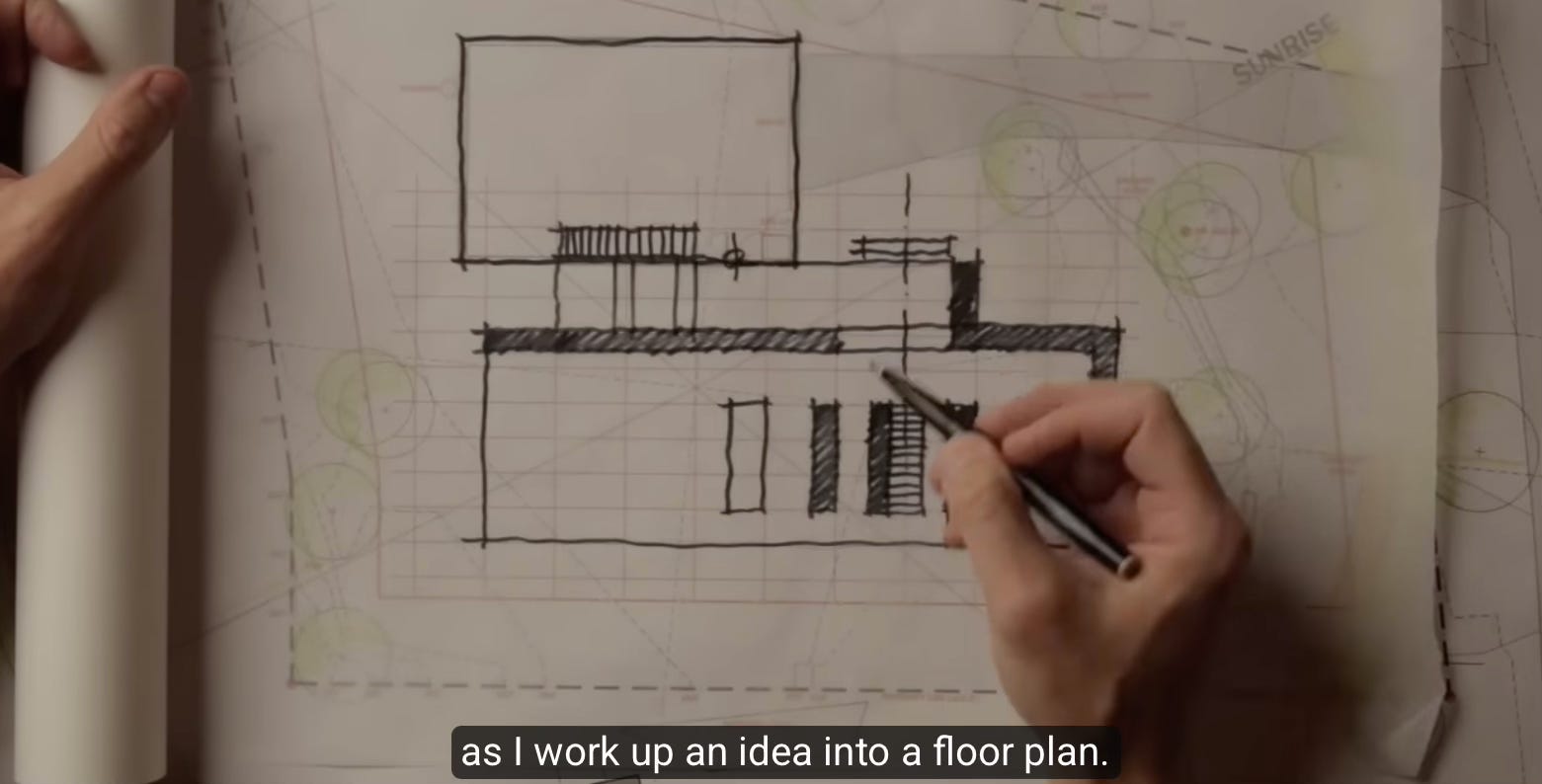
Good architects don’t work linearly or sequentially but iteratively.
In other words, they don’t evaluate options after the fact, they iterate, and the setting of intent (what problem are we even solving, what should this building mean or do) happens not after but before idea generation.
Translating a client’s vague, often contradictory desires into a design program isn’t curation but discovery and interpretation.
The architect as moat
In addition to professional judgment, decision making and management, there’s of course legal accountability.
Someone has to stamp the drawings, take on responsible control of document creation and carry liability insurance.
No matter how good an AI model gets, licensure ties professional responsibility to a human.
That’s an institutional and legal function that will likely become more central for architects, the thing that can’t be automated-away regardless of AI’s capability.
But legal accountability only adds to the list of items the architecture profession (looking at you AIA and NCARB) will need to rebrand.
Focus group benefit testing Take 1: Professional judgment, decision making, management, legal accountability. That’s what it means to be an architect now!
Focus group benefit testing Take 2: Become an architect so you can leverage your professional judgment and decision-making capabilities, management acumen and legal accountability!
Most architects do not design.
Most people go into architecture to design.
Both can be true.
To stay an architect in the age of AI, it is likely you will need to take on one or ideally more of these non-design tasks. Designer’s, too.
While we are discussing unappealing tasks, add to this list construction administration (or as our attorneys prefer that we call it the less agentic construction observation.)
Weasel words.
Assuring the role of the architect remains a messy job will become increasingly important in the age of AI and construction administration, which is physical, situated and messy in ways management isn’t, and will continue to be a differentiator for architects moving forward.
Site conditions never match drawings. A contractor calls with a problem at 7AM because a beam won’t fit a real-time problem-solving in physical reality, closer to fieldwork than stakeholder management or anything that AI (as of now) can address.
Point architect.
Taste will be needed. Context will as well. It’s safe to say architects will be needed well into the future, but when and how?
The 10% rule
When students and mentees have asked if they can practice without having to learn Revit or related tool, I have invoked what I call the 10% rule.
If you would like to spend the rest of your days designing buildings by hand?
Or say you would like to spend the rest of your days designing buildings period, 10% of architects can fairly take on this role.
They’ll be the exception, but it is OK being the exception. If it is kept to around 10%.
Despite AI budging into our practices, design authorship will likely persist longer than one might anticipate, at least for firms whose value proposition is a recognizable or signature design language. AI-generated options are only as good as the taste and concept behind them, and for 10% of high-design practices that taste is the product or service, not a filter applied after AI produces fifteen massing studies or facade variations.
So, let’s reframe it less as AI generates, architect judges and manages and more as:
AI compresses the exploratory/technical middle of the process aka design development, while the beginning (schematic design, which includes interpreting intent), the end (construction administration, with its focus on physical execution and accountability) and the throughline (managing complex relationships and legal responsibility) stay human.
Judgment threads through all of these rather than residing in its own separate box.
We ought to diagram for this, a before and after showing how architecture is both taught and practiced now vs. how it will (or ought to) be taught and practiced in the near future with AI in the world. Something like a MacLeamy curve but instead of IPD for AI.
Future-proofing your career
Architecture schools have not yet attempted to future-proof what they teach so students have taken it upon themselves to do so.
By leaving architecture for construction. Full stop.
As I have written elsewhere, most of my undergraduate male students have left for construction or construction management jobs and my female students have said they would do the same if they felt that construction was more supportive and accepting of their gender.
Many of my university’s undergraduate students are leaving architecture for fields that they feel are more AI-proof and thus future-proof such as construction and construction management. I would like to encourage them to stay in architecture since I found a career in architecture over the past 40+ years to be extremely rewarding.
And because they are 100% wrong to think that construction is any more future proof than architecture. In fact, it’s less safe from AI.
More on this in a moment.
Trying to convince students to stay in architecture, though, is a tough sell for those who have parents concerned about their long-term career prospects.
How to pitch a career in architecture now that AI is here
What are architecture’s key selling points? How will things likely change from when I was in school and became an architect and for my current students?
First, I would like to gently push back on the premise with them. Gently, because many of my students have already made this decision and were not open to having me challenge or talk them out of it.
That construction and construction management are more AI-proof isn’t true.
It’s just that the automation is hitting there less visibly right now.
You’ve seen the charts and diagrams that anticipate what percentage of each job will be automated in time by AI. Well, architecture and construction, clumped together (often with engineering), are similarly impacted.
Clash detection, scheduling optimization, cost forecasting and construction sequencing are already deep into AI adoption on the construction side, and robotics and automated fabrication will hit construction labor over the next decade in ways drafting and modelling haven’t yet.
Every field touching the built environment is being reshaped.
The better messaging isn’t architecture is at risk, other fields aren’t, it’s every field is being restructured, and the question is which restructuring you’d rather be part of?
While not every architect designs, no one designs in CM
One day my former architecture students, who went into architecture to design buildings, will wake up as well-rested and wealthy construction managers and may have a reckoning wondering how they got where they are?
So, parents of my former and future architecture students, chill. Your parental anxiety needs to turn way down. Stop treating this as a binary safe/unsafe choice.
Remember when you told your children to study computer science? How’s that working out?
Leave your kids careers to the pros. We’ve got them covered.
The split, anyway, isn’t architecture-vs-adjacent-fields, it’s task-type within every field.
We know by now the tasks most exposed to automation, while decisions requiring judgment, contextual understanding and relationship management are where architects stay indispensable.
Focus group benefit testing Take 3: Judgment, contextual understanding and relationship management: stay architects, and stay indispensable.
One estimate suggests around 30% of design, drafting and modeling tasks could be automated, which doesn’t mean 30% of jobs vanish, but that entry-level and production-intensive responsibilities at the bottom of the career ladder are disrupted.
It’s a disruption of how students and soon to be graduates enter the field, not of whether the field has a future. The field has a future.
Only, how do we get this message across in a compelling way?
One that people hear?
Selling points for architecture students and their pesky parents
Optimistically, as we saw with parametric tools then computation, AI may level the playing field between large and small firms, letting lean teams produce more, compete for bigger projects and operate with fewer people which could mean students who stay have a shot at running their own practice sooner than my generation, rather than spending 15 years in production roles at a big firm first.
But beyond this, what will convince architects to become then stay architects?
Licensure → Despite living in unregulated (or at least deregulated) times, it is licensure that will save you. Someone has to stamp the drawings and carry the liability. And that someone is unlikely to be named Claude. No matter how capable the tools get, legal responsibility for life-safety systems stays attached to a licensed human. That’s not one of the soft skill arguments I made for the architect in Superusers (2019, Routledge), but it’s worth saying explicitly to parents who think in terms of job security.
Conceptualizing → If AI absorbs redlining, dimensioning, room tagging and code-checking, time spent conceptualizing, in client engagement and the throughput of design intent, the parts I found most rewarding over my 40+ year career, goes up, not down. Chalk that up to being not just a defense against obsolescence but an improvement in day-to-day job satisfaction.
Synthesis → Architecture is a synthesis discipline whereas construction management is an execution discipline. Besides onsite strategy, CM optimizes delivery of someone else’s design decisions. Architecture is where you decide what’s being built and why, simultaneously across aesthetic, technical, legal and human constraints. If a student is drawn to ambiguity and making judgment calls, architecture keeps more of that than CM does. CM is arguably more exposed to optimization/automation long-term because its core function related to sequencing, scheduling and coordination is more rules-based than architecture’s.
Lastly, physical and civic legacy → Buildings outlast careers. Immortality is a selling point and this dinosaur architect the living proof. I’d let my own 40 years do the pitching, and suggest other lifelong architects do the same, rather than treating one’s career and legacy as an add-on.

Rebranding architecture schools and practice
Be honest rather than salesy, because students and parents can smell spin.
There are legitimate reasons students are looking elsewhere besides wanting to please their parents (as if) and avoiding career obsolescence.
Compensation-per-hour in architecture has long lagged adjacent technical fields. AI can improve the economics for architects. How?
AI-driven efficiency, if firms restructure their fee models around it via value/outcome billing rather than hourly, could improve the economics of practice over the next decade. Not yet a guaranteed but a real possibility.
The traditional apprenticeship model where interns learned judgment by spending years doing production work is going to erode, because the production work is what’s being automated. But if we’re honest with ourselves, that boat shipped in the 1970s.
Schools and firms will need to design deliberate ways to teach judgment without the years of grunt work, because it means their early career will look different from ours in ways that require educators and their employers to actively build new training paths, not just assume they’ll absorb judgment over time by osmosis.
Rebranding for our AI future
Want more linear, execution-focused work? You’ll probably be happier in CM.
If you’re the kind of person who likes wrestling with ambiguous, competing constraints and wants to shape what gets built rather than how it gets built, that’s not only not going away it’s becoming a larger share of the job of the architect.
Now that we got that out of the way, should I continue to spend time, now that AI is here, emphasizing the topics of professional judgment, decision-making and management?
Reframe judgment as design authorship
To answer my own question, yes, but I’d argue I’m only making explicit something that was always the substance of design excellence.
Design judgment was just learned and taught implicitly, through studio desk crits and reviews, rather than directly via lectures and readings.
What’s changed isn’t that judgment matters more now that AI is in our workflows, it’s that AI compresses the time between having an idea and having fifty variations of that idea, which means the bottleneck skill i.e. knowing which one is right and why becomes more urgent now compared with when generating options was the bulk of our labor.
The case for spending more time on design judgment with AI in our workflows doesn’t require us to add a soft-skills component to studio, it’s closer to the thing desk crits were always about is now the main event. So, let’s stop treating design judgment as secondary. With AI here, design judgment needs to be our main course in architecture school. Full stop.
On making professional judgment appealing
You could argue until you’re blue in the face that what distinguishes architects from those who play them on TV and movies is professional judgment. But it wouldn’t matter because no architect wants to hear that is their differentiator (where again, professional judgment = knowledge + experience + intuition) but instead g-d-given talent, genius and the dedication of long hours.
At the risk of having one of my current students read this (as if), here are the keys to the kingdom:
Adding the prefix design to the tougher to swallow and keep down judgment helps, so the problem and solution are partly improved branding.
Design judgment has a nice(r) ring to it.
1 down, 98 problems to go.
Professional judgment, decision-making and management sound like so much HR training. Designers already have language for these things that they find compelling:
Judgment becomes → the eye, editorial voice, design editor, and authorship.
Every student wants to develop “an eye” which sounds aspirational, not administrative.
Decision-making becomes → conviction, comfort with ambiguity, and commitment under uncertainty.
Reframing a choice as commitment made without full information is dramatic, the moment in every design process students remember, the why did you kill your favorite option moment.
Management becomes → orchestration, stewardship and advocacy.
A film director doesn’t operate the camera and a conductor doesn’t play every instrument. Students respond positively to this analogy because they secretly want to become film directors it reframes management as authorship practiced through other people. And unlike administration, it’s cool.
Advocate for active case studies and practitioner narratives
This is how we make these topics more appealing by rebranding them in the curriculum and in practice.
What other ways beyond wordsmithing might we pursue to address the topics of professional judgment, decision-making and management without using these words?
Restructure the exercise, not just the label
My studio students already do precedent studies but doing so really only trains them to see buildings as objects, reinforcing the idea that the interesting work ends at the design decision and everything after is bureaucratic mop-up by the relief staff.
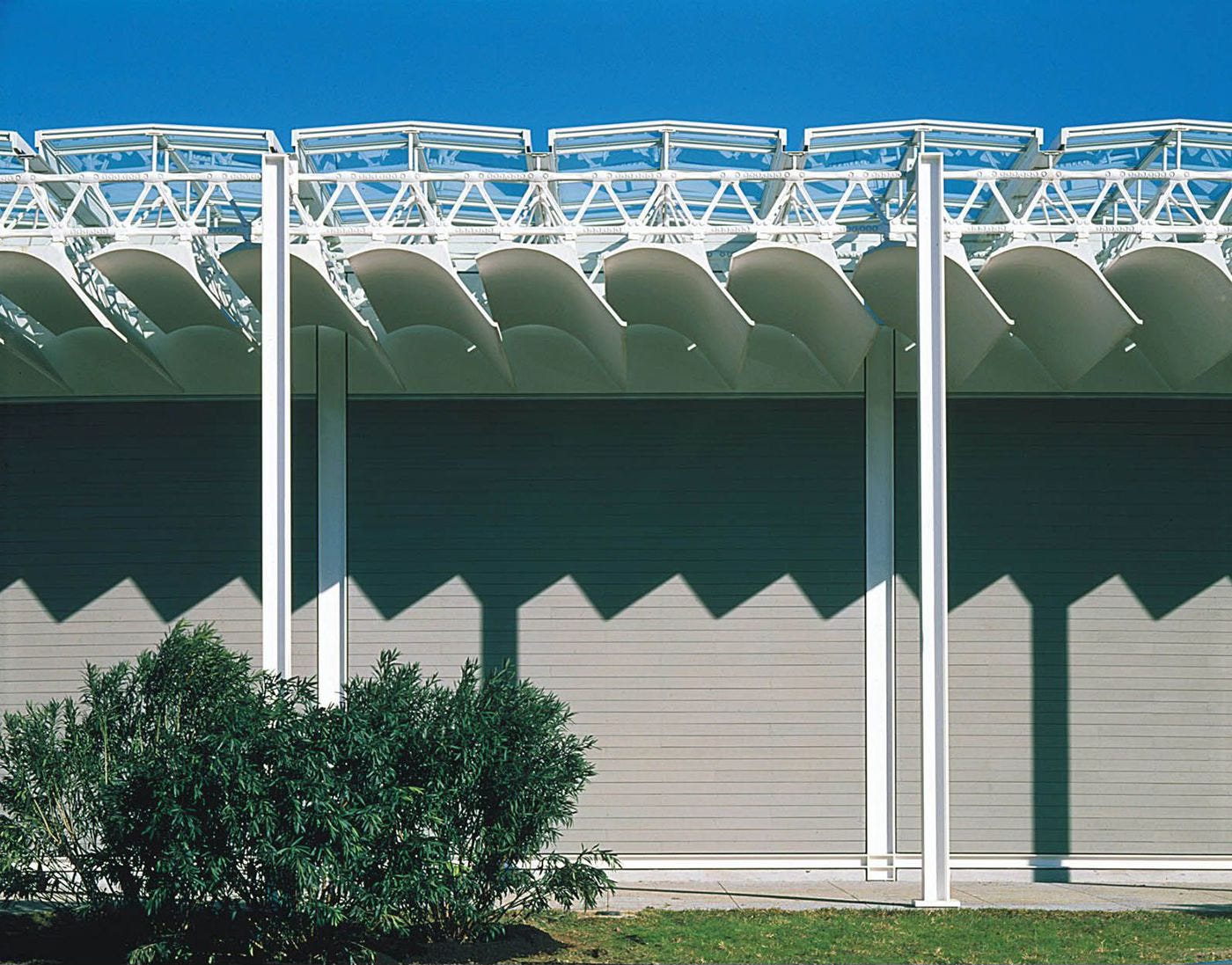
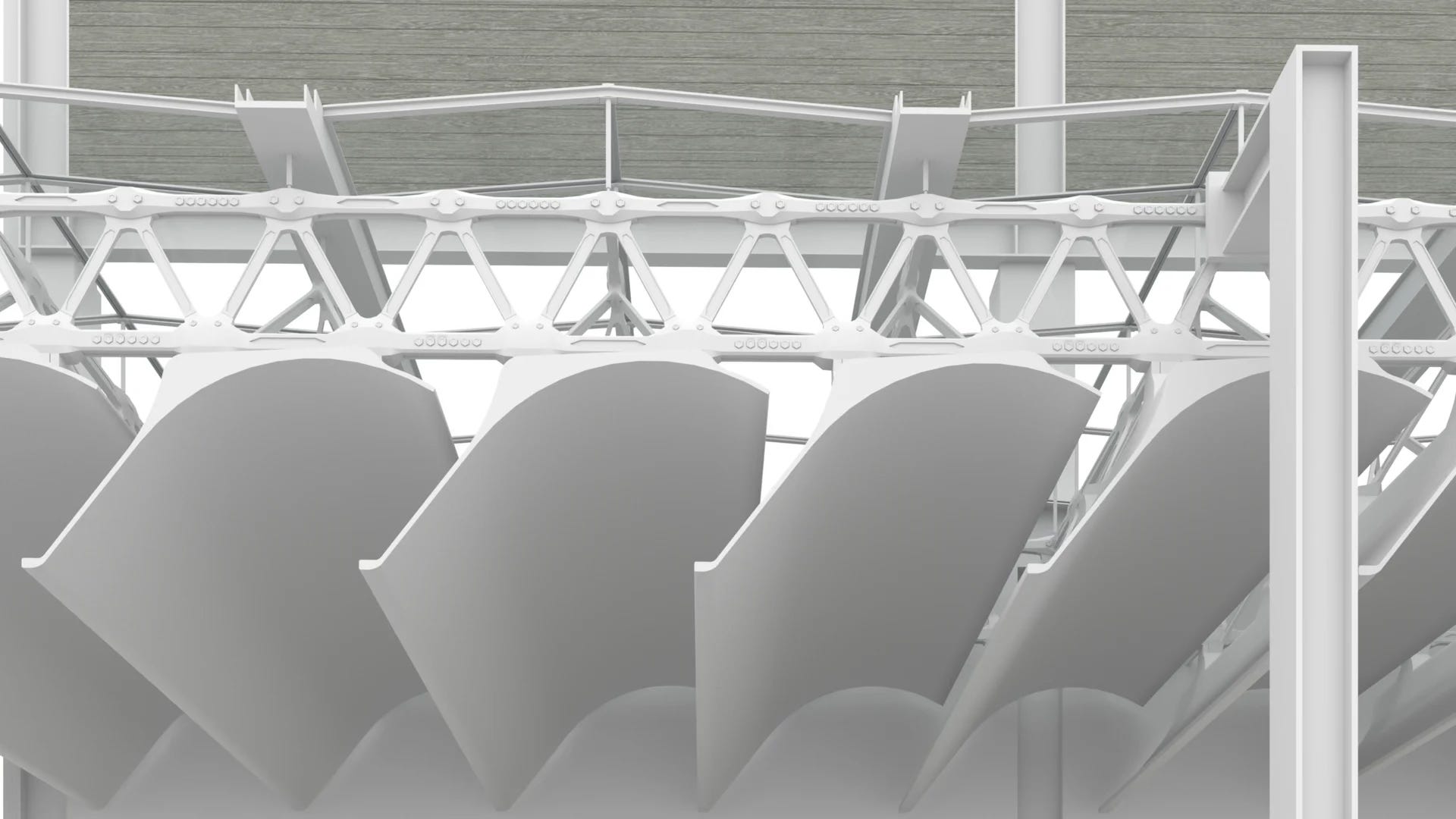
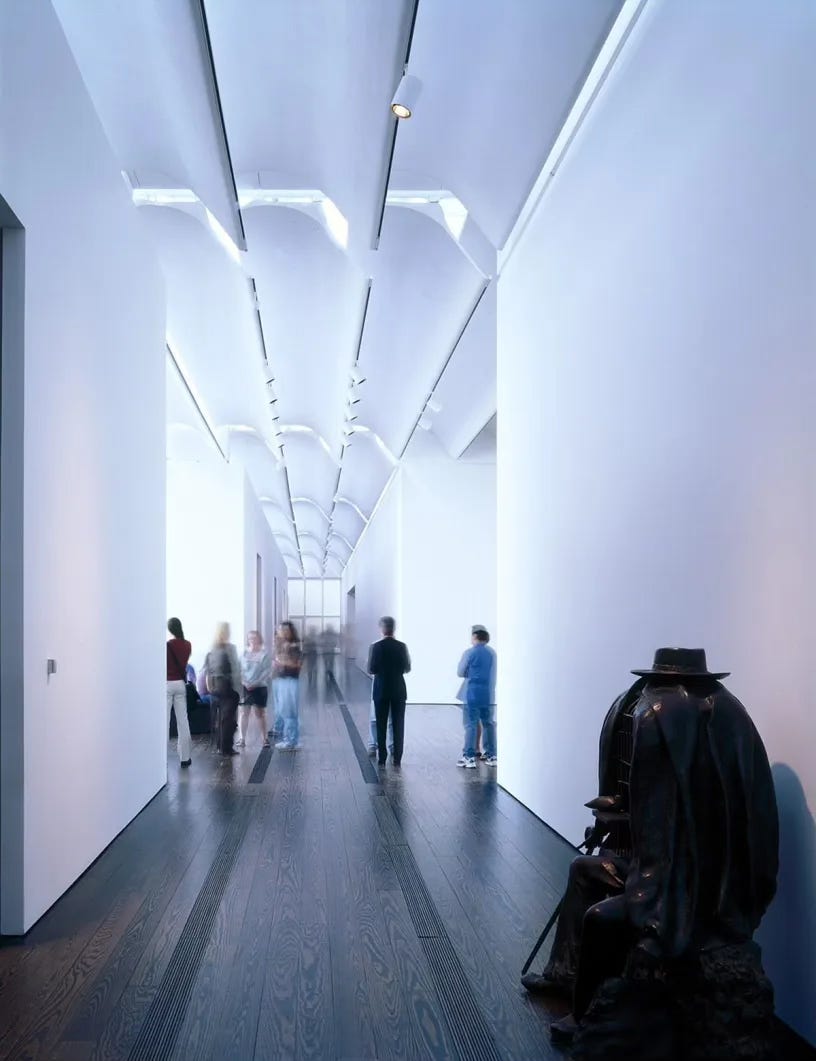
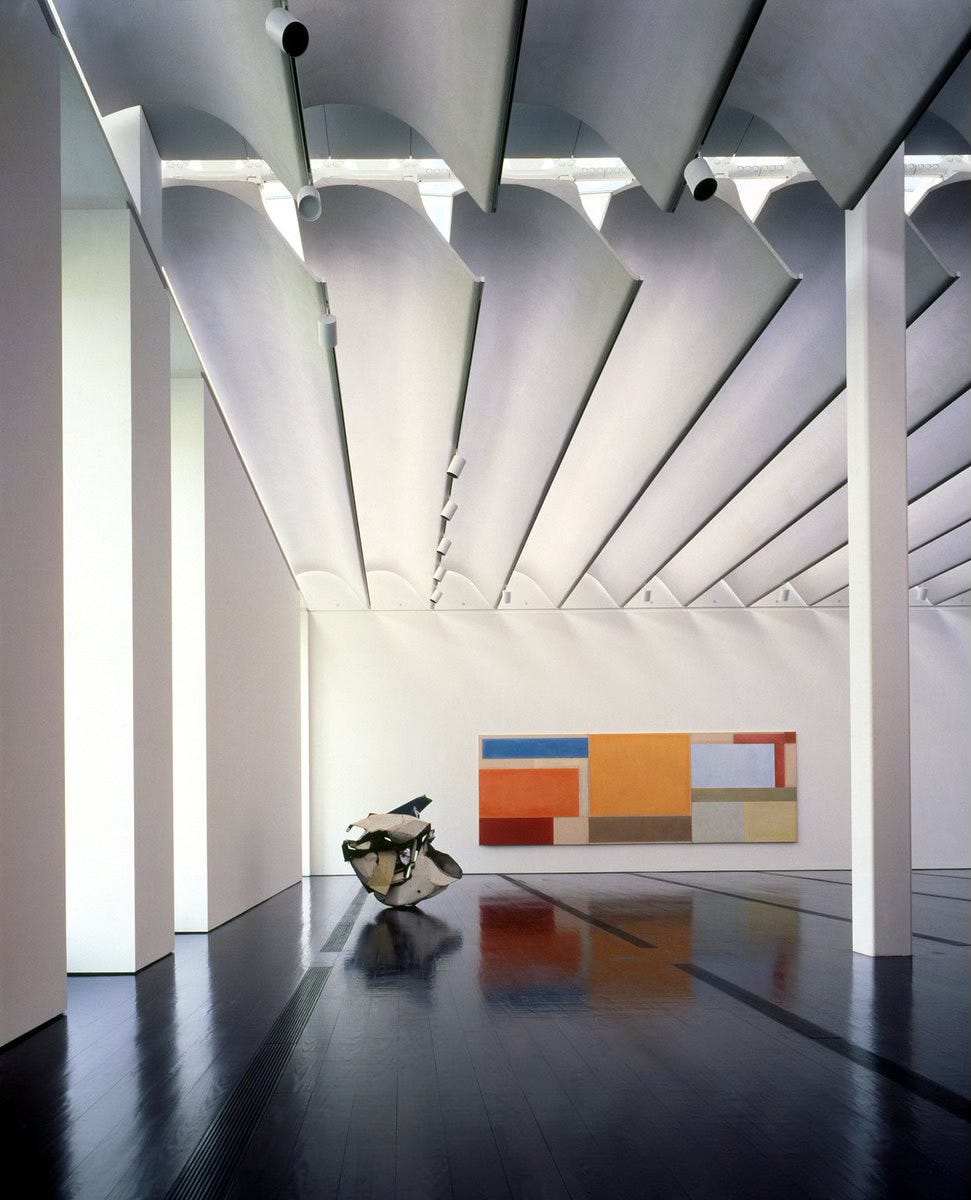
Instead of here’s the Menil Collection, notice the light scoops, (precast ferrocement roof baffles) I could present to them three schemes that were originally considered for an unfamiliar project, strip out which one got built and have students argue for one before revealing the answer and the reasons it won. That forces them into the decider role instead of admiring, emulating and too often what ensues in studio, literally copying, it from outside.
Since I started my career as both an architect and a playwright, I’m well-aware of the advantage of building suspense and using conflict to gain interest. This is why I often use conflict-driven case studies. Utzon and the Sydney Opera House, Wright’s or Corbu’s client tensions, any project where the built result diverged under immense pressure from the architect’s intent, these are dramatic stories and management is just another word for surviving that drama with your design intent intact.
Management is just another word for surviving the drama with your design intent intact. – from the classic 1971 hit Me and Bobby McGee popularized by Janis Joplin
Students respond well when it’s told as narrative rather than taught as a competency.
Do you?
Now for a trigger warning. This idea may be ahead of its time but hear me out.
Make AI do the option-generation in studio and grade the selection
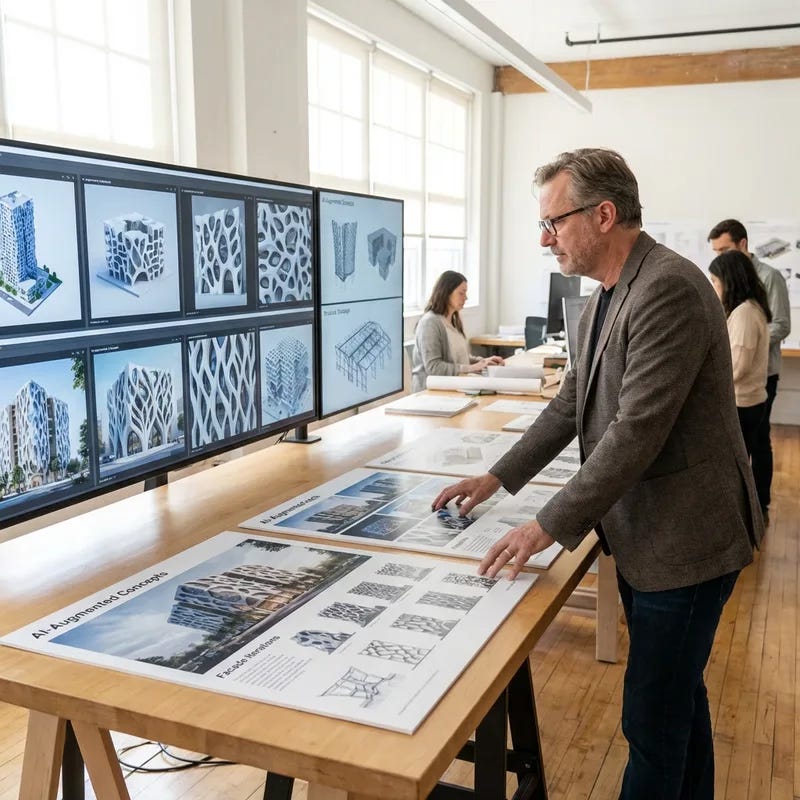
You heard me right. I have my students generate a dozen massing or facade variants with AI, then require from them a written or verbal defense of the one they’d build and why they killed the other eleven.
Make judgment the deliverable. Try it.
This is the most direct way to make the now-that-AI-is-here decision-facilitating skill I’m trying to teach unavoidable and explicit. Students can’t opt out of practicing judgment if the exercise is structured so that not the design itself, but judgment is the deliverable.
Lastly, I like bringing in guest speakers to spice things up, not to lazily have them do my job for me in every class meeting. SO, try bringing in practitioners (or better yet, be one yourself) to narrate one real, specific, contested decision. Period. Not a career retrospective, one decision. Not a these are some of my favorite things lecture, one decision. Told with the stakes and the person who almost overruled them. Specificity is what makes stories like this feel like drama instead of one of my interminable lectures on professionalism.
Case studies and precedents can absolutely carry the day and deliver the goods, but only if restructured around the choice rather than the outcome.
Are we up for this? It will require our focusing on process over product – something architects have not shown a speck of interest in – so I am not convinced this will work.
A precedent study that ends at here’s what got built teaches formal literacy.
A precedent study that starts with here is the problem we tried to solve, here are the options, you don’t get to see the answer yet teaches the skills of professional judgment, decision making and management, and is also just a more interesting class to sit through.
Who We Need To Be
With AI handling most knowledge work that architects will be needed primarily for their professional judgment, decision-making and management; that’s who we need to be; so, be open to and learn these implicitly, explicitly, and in every way possible; and pronto; the need to do so is imminent.