Ghosted by the machine
Why more of us are being met with silence and what to do about it

“Ever tried. Ever failed. No matter. Try again. Fail again. Fail better.” – Samuel Beckett
After eight years of being ghosted, just like that, it stopped.
Not because people stopped ghosting me but because I stopped applying.
We decided to go in a different direction
Are there 8 words we hate more to receive than these?
We decided to go in a different direction
In fact, there are six words that sting even more, for they create less legal exposure for HR and the firm who communicates them by removing the agency of “decided.”
We went in a different direction.
That’s the world we find ourselves in today.
Only the direction is never the one you are going in. You find yourself walking across a desert toward the horizon and they thank you for your interest but no matter the direction you are headed, they have gone in a different one.
Which direction? Not the one you’re going in, or trying to anyway.
What it means to be ghosted
If you feel you have been ghosted, nothing I can say can undo what led to that.
What I can do though is try to improve your prospects moving forward; help make the desert you are crossing feel a little less desolate and alone; and provide you with some tools and insights to take with you on your career journey.
What I will set out to do here is to explain what ghosting is and isn’t, why it happens, how to recognize when it happens and when it doesn’t, and without blame or finger pointing why you are likely unnecessarily making things worse for yourself, not improving but diminishing your chances of moving forward by misinterpreting what it means to be ghosted today.
In the past we were concerned with the ghost in the machine, the separation between the mind (the ghost) and the body (the machine). Now, due to Applicant Tracking Systems (ATS) and AI screening tools and other digital gatekeepers of the modern job search our reality is where we are ghosted by the machine.
After eight years of being ghosted
It stopped. Not because people stopped ghosting me, but because I stopped applying.
I stopped looking. Stopped asking, stopped inquiring, stopped seeking.
I’d have none of it.
Dear Director Rodriguez,
I am writing to express interest in serving as a Clinical Professor in the UIC School of Architecture…
or
Dear UIC School of Architecture Director Search Committee,
I am writing to express my strong interest in being considered to serve as the next Director of the School of Architecture at the University of Illinois Chicago…
Their response?
Tumbleweeds. Silence. Nada. Nothing.
After being forced to sign a termination contract in 2024, I tried my hand at finding a backup position elsewhere.
So, I applied for a clinical position at UIC then heard nothing, and then when it was announced that UIC was seeking a new director, for the UIC Director position. Nada.
At this point in my career, I’ve thrown my hat in the ring roughly 1,000 times over the past 8 years and had my ass handed back to me each time. Only silently.
I am certain if I continued applying for jobs, awards, anything, the ghosting would continue and this post would be even longer than the 13,500 words it already is.
So, I stopped.
You’ve been ghosted
Sound familiar? I am here to report that no one even bothers to reject you anymore. I would be flattered if I received so much as a rejection. I would be so grateful to receive an actual rejection that I would send the person who bothered to reject me flowers or chocolates for doing so, which likely explains why no one bothers to so much as reject you anymore. Awkward.
I also applied for an administrative position at my own university’s UIUC School of Architecture, interviewed over and over for months, meeting with committee after committee, and in 5 years have never received a response one way or the other.
Not an acceptance or a rejection.

I am like the Tom Hanks character in the 2004 comedy-drama film The Terminal, where he is stranded in the international transit lounge of New York’s JFK International Airport after a military coup invalidates his passport.
In perpetual limbo.
Who interviews for a job and never hears back? It turns out almost everyone.
So why during those 8 fruitless years did I keep putting myself out there?
Here’s where the Helen Keller quote I keep requoting bears re-requoting:
“Life is either a daring adventure or nothing. Security does not exist in nature, nor do the children of men as a whole experience it. Avoiding danger is no safer in the long run than exposure.” – from her 1957 book The Open Door
Because life is either a daring adventure or nothing. That’s why.
But then earlier this year I just stopped putting myself out there. Just stopped applying altogether. I’d have none of it.
This is what I found: Life is good on the other side of striving.
But waiting for something to fall from the sky into your lap isn’t a business model.
That’s’ why I’d advise that you keep throwing your hat in the ring.
I know some people who only go after sure things. Where they are told if they enter, they will win.
Several decades ago I worked in a firm that was involuntarily shortlisted for a commission to design a high rise in a major city. The firm principal wrote back they we didn’t do competitions. If they wanted our design, they should call and ask. The competition proceeded without us, but when the client apparently didn’t like any of the entries, they called and asked. Within 24 hours we submitted our design and we were awarded the commission.
The resulting high rise was better than either the optics or our ethics.
Now I try to stay above the fray.
A numbers game
When I was a playwright in the 1990s, I submitted my plays unsolicited (each with a self-defeating self-addressed stamped envelope) to hundreds of theaters and entered my play in hundreds of contests. The result of all of this cost and effort?
I won one Pasadena, CA theater contest. And another theater in Nebraska did a production of my play, and another in Columbus, OH did a reading of my play.
Rob Krier, Leon’s brother said he entered 67 competitions until he won one.
So why keep doing this to yourself? Because you learn just like the more ideas you have the better chance you have of having a good one, so too the more times you enter the more likely you are to see some success.
While this is in my experience mostly true, does following-through on this make you a masochist, deluded or a defeatist?
At what point do you revisit your strategy or after how much rejection (if you are fortunate to receive a rejection) or more frequently to receive silence, decide you’re barking up the wrong tree?
I had a friend who would only ask out unapproachable girls in his high school class. After three years, he had exactly no dates to show for his strategy or perseverance.

That was then, this is now
Rosencrantz and Guildenstern are Dead by Tom Stoppard is a brilliant 1966 absurdist tragicomedy that retells Hamlet from the perspective of two minor Shakespearean characters.
The play opens backstage with the title characters flipping coins. In a shocking defiance of probability, the coin lands on heads nearly 100 times in a row.
Guildenstern attempts to use philosophy and probability to explain the impossible streak, while Rosencrantz is largely indifferent, simply collecting the mounting pile of coins.
This opening perfectly establishes the play’s core themes: a lack of free will, the absurdity of the universe, and the realization that the duo are trapped in a larger, pre-written narrative (Shakespeare’s Hamlet) where the outcomes are already determined.
A hundred times in a row. It’s absurd. That’s the point.
You need to enter to win
Lots of Buddhists and meditators like to repeat this line:
You need to be present to win.
I have firsthand experience that this isn’t entirely true. My father died when he was 42 in the 1970s. The last thing he did in his life, after being in remission for 5 years, was go after an award in Philadelphia. He told my mother on his deathbed that he was confident he had won.
He did win, she learned, the day after he had passed away.
Why do we keep at it? Why do we enter over and over again despite the odds and the radio silence at the far end?
If you enter, that means you are alive. Still in the game. There is still hope.
Because life is either a daring adventure or nothing.
Only what stands in our way today isn’t rejection but ghosting. Being ghosted.
Case in point. I used to speak annually at the AIA Conference. Up until 2018 I’d enter 3-5 proposals and they would accept 1-2. They’d assign my talk for 7Am on a Saturday or 6PM on a Friday – awful, rude behavior on their part – but an acceptance is an acceptance. Don’t look a gift horse…
Then I received my ‘F’ by becoming a Fellow and you know what? 100% of my proposals have since that date been rejected.
100%. A coincidence?
Rejected by AIA since 2018
After an architect who attended my 2018 AIA Conference workshop presentation wrote saying it was “the best presentation I have seen in 3 years,” and one senior colleague called a presentation I gave that year “probably the best presentation about our School of Architecture I have ever heard in all my 34+ years here on campus.”
The result? Ghosted.
Can’t fault me for not trying.
I have since entered multiple times, even entered with others including racially and gender-wise diverse lineups of speakers and topics and was still rejected 100% of the time since 2018.
The F in FAIA must mean not fellow or finally but failure.
F puts you in an entirely different category
They tell you that as a fellow you’re among only 3% of AIA members. Rarified air.
But still 100% of the time rejected.
I will spare you listing all the things I have been ghosted from since 2018, but it is literally everything.
Friends in high places would lecture at universities and colleges and afterwards reach out to tell me they nominated me to be the school’s next director or dean.
None of these got past the initial interview stage.
Working 80 hour weeks as a senior designer at a Michigan Ave architecture firm in Chicago, I would always seek more by reaching for the golden ring, always keeping one hand in play, in hopes I could spark something.
“You can’t start a fire without a spark.” – Bruce Springsteen, 1984, Dancing in the Dark
That was me. The world? It put me in my place.
Two can play this game
Being ghosted is exacerbated by today’s AI-driven ATS online job application gatekeeping interfaces and Zoom job interviews with an AI.
When applying to HOK I tell my students to type the word Revit 7 times on the bottom of their resumes to see what happens when they upload them to their ATS online job application system. My students tell me that they have a much higher positive rate of response. This technique works for other firms, using other words, depending on their culture and what they are looking for. It raises a different question: What is the ATS looking for? Likely, for starters, feeding back the exact language used in the job posting.
Why do firms ghost applicants and others? Legal reasons. Some nefariously put out job ads without any intention of hiring (“We went in a different direction”) Some are gathering data on who is out there, trying to come up with language to use in a later actual job search; or to test the waters, see who is out there, or to signal to competitors “we are so busy, we need to hire!” I know of one firm that for the past 15 years has repeatedly put out ads without evidence that they have ever in that time hired anyone. Why otherwise would they bother to do this?
What worked for me
There are things we can do to improve our chances of being seen or heard.
There is ample evidence, for example, that emailing Tuesday 7AM CST is the best time to email if you want to get a response. I’ve tried this for years and it works. Email Tuesday 7AM CST and you will not be ghosted.
And these 6 small words have always worked and saved me by getting me an email response if previously ignored or ghosted. All small case:
resending in case you didn’t receive
It works. Every. Single. Time.
The word you can be triggering, divisive, and I try to avoid it.
But have never come up with 6 better words that work 100% of the time.
Rejected? Respond with these 3 words:
Help me understand
To the recipient of these words, they are disarming. Ask these three words and the world becomes your oyster.
I once suggested to an undergraduate student they use these three words (Help me understand) if a prospective employer told them they don’t hire undergrads. Years later, when I served as Associate Director of Graduate Studies at UIUC, one of my responsibilities was to read all of the letters of recommendations for our undergraduates applying to our graduate department. One such letter from an employer of one of our past students who, when told years earlier that they don’t hire undergraduates responded with the three magic words, Help me understand. The employer explained that it was the most mature thing he had ever heard uttered by a job candidate of any age, hired them on the spot, and they have since become one of their most valued employees.
Reading this was very meta as I was the one who suggested to the student that they use these three words:
Help me understand.
Try and try again.
I serve on juries. If you sought AIA fellowship but didn’t receive your ‘F’ or entered but didn’t win an AIA Architecture award try again next year. Is there evidence that if you try a second or third (or, gasp, fourth) time your chances improve?
Indeed. It’s a numbers game. You have to enter to win. The more times you enter, the more likely you are to win. So it pays to be stoic in the face of defeat, not respond emotionally, persevere, and repeat as necessary.
In 1989 before moving from Princeton, NJ to Chicago I reached out to 20 firms requesting an informational interview. Most granted them. I visited each in person. I interviewed at DLK, Mozart blaring in the lobby and throughout the office from the speaker system. Kevin Kemp came out to interview me, saw on my resume I was a writer, and said I should speak with his partner at the time, Howard Decker, who was also a writer (for Inland Architect Magazine from 1988-1996 for 8 years.) Howard suggested I work for Dirk Lohan at Lohan Associates, (and put in a call to Dirk on my way over to their office, sight unseen, to see if they would meet with me)
Diane Legge FAIA was Dirk’s former wife, and Kevin Kemp (the ‘K’ in DLK) Diane Legge’s current husband. It was all a bit comfy, making Chicago feel more like an oversized small town than a large city, which isn’t wrong. I have lived in this tiny town happily now for 38 years having worked fruitfully eventually for all of these architects.
My interview at Lohan took exactly 8 minutes. I met with then Dirk’s partner, Joe Antunovich, who never looked at my portfolio or resume, said he liked my tie, asked an Associate of the firm who they said reminded them of me to give me an office tour. I got the job at Lohan and worked there for 7 and a half years.
I recognize these were different times and that 2026 is not 1989.
I mention this anecdote because I put my future into my own hands. I didn’t just apply online (for one thing, there was no online in 1989) but went uninvited in-person to each of the firms on my list. Yes, even then receptionists were gatekeepers. But this is also true: be nice to receptionists; ask them how their day is going; smile; when they put in a call saying I was there to see so and so, most came to the lobby to either explain that they were busy and couldn’t meet with me, would I please leave a copy of my resume with the receptionist; or alternatively, sat down with me to talk for an hour or, in the case of Joe Valerio, 1 and a half hours; in the case of Howard Decker, two hours; and Steve Wiersbwski or Florian Wiersbowski, at the time the hottest firm in Chicago, three.
The ghost in the machine
Briefly let’s return to look at the provenance of the term ghosting, which as social slang (cutting off contact) is relatively recent.
The term ghosting in its social sense (abruptly cutting off all communication with someone without explanation) began gaining traction around 2014–2015, when it started appearing in mainstream media and dating advice columns. It gained enough cultural footprint that Merriam-Webster officially added it to the dictionary in 2017. The rise of smartphone culture, dating apps (Tinder launched in 2012, Bumble in 2014), and social media made ghosting both easier to do and easier to notice, since you could clearly see someone was active online while ignoring you.
Situations where ghosting occurs
While it originated largely in dating contexts, then moved to friendships, the term has expanded to the professional realm.
Ghosting now has a professional and especially job-hunting application and is the major modern frustration I am focusing on in this post. Employers ghost candidates after interviews, or job candidates ghost employers and simply don’t show up. It’s become common enough that HR professionals write about it. Relatedly, a potential client, collaborator, or business contact goes silent mid-negotiation or after expressing interest.
Beyond architecture, patients ghost therapists or doctors by missing appointments without notice, sometimes even after making progress, and in online communities someone you’ve been chatting with online simply vanishes or inexplicably blocks you without word.

Caspering and other variations
The concept has spawned a whole vocabulary of related behaviors: soft ghosting (where others are still technically there liking your posts occasionally but never responding to direct messages); the slow fade (where there’s a gradual reduction in communication frequency rather than a sudden cutoff); haunting or lurking (where the ghoster reappears by watching your stories or liking old posts without re-engaging); and zombieing (where, as the term implies, the ghoster comes back from the dead months later as if nothing happened, often with a casual “hey.”)
We’ve all experienced variations of ghosting including breadcrumbing (sending occasional, minimal contact to keep someone interested without real commitment); benching (keeping someone on the sidelines while pursuing others; we see this all the time with recruiters who string you along); breaking, where Ross in Friends, famously yelled the iconic line, “We were on a break!“ to defend sleeping with Chloe; blocking, orbiting and my favorite, caspering (friendly, gentle ghosting aka letting someone down kindly before disappearing.)
Ghosting can be damaging because it denies the person being ghosted any closure or explanation, leaving them to ruminate and often blame themselves, essentially treating a person as if they don’t exist or don’t deserve acknowledgment, where you are left to feel the pain of social rejection.
On the flip side, people who ghost often do so to avoid conflict or confrontation, protect their own emotional comfort, or simply because digital culture has made it physically easy to disappear. The lack of face-to-face accountability in online interaction has normalized it significantly. Similar to my nearly getting run over by someone everyday who is driving a pickup truck. Up above pedestrian life, protected in their steel cab, it must make the driver feel like there’s no face-to-face accountability for running over someone rightfully in a crosswalk.
Is ghosting rude inconvenience or a reasonable boundary? My architecture students tell me that they frequently feel that they have been ghosted by employers. When I ask then to elaborate, my students say that they apply to firms online but seldom hear anything back from the employer, not even a rejection.
Is it ghosting?
Is this ghosting or something else? At what point would you say that my students are being ghosted vs. just an expected part of the job application process?
This gets at something important in modern hiring culture. What my students are describing exists in a gray zone.
When it IS ghosting
When a prospective employer disappears without acknowledgment or explanation, it’s ghosting. Full stop.
A firm that receives an application, reviews it (or even doesn’t) and never sends any response has vanished on the applicant. The applicant is left wondering, waiting and often blaming themselves. They’ve been ghosted.
When it ISN’T ghosting
Ghosting in its purest social sense implies a pre-existing relationship or exchange. You’ve talked, matched, interviewed, or connected. A cold application to a firm that never acknowledges you is closer to sending a letter into a void. There was no relationship established, so there’s less of a personal betrayal involved. That doesn’t mean it doesn’t still sting.
Reasonably expected (not ghosting)
No response to a cold application submitted through a general portal, especially at large firms that receive hundreds of applications. Many firms use automated filtering and simply cannot respond to everyone.
No response after a very early-stage inquiry (e.g., emailing a firm speculatively without a posted opening).
How about delays of several weeks? Architecture firms, especially smaller ones, are often busy and understaffed in HR. This behavior can be reasonably expected.
The gray zone
How about an automated we received your application email, followed by permanent silence? Technically they acknowledged you, but it still feels like a applying into a void.
And what about applying to a firm with a posted opening and hearing nothing for 4–6+ weeks? At this point a follow-up is reasonable, and continued silence after that follow-up edges toward, you guessed it, ghosting.
Clearly ghosting
A firm or recruiter reaches out to you with interest, then goes silent. We’ve all been there.
A phone screening or first interview occurs, and the firm, despite saying they would, never follows up. Yup.
Multiple interview rounds happen, references are checked, and then…nothing. Check.
This is the most egregious form of ghosting and inexcusable as professional behavior.
A firm explicitly says, “we’ll be in touch by [date]” and that date passes with no contact even after a follow-up. Even if they contacted you a month later, would you even at that point want to work for them?
Why architecture may be worse
For the following reasons, my architecture students may be experiencing this more acutely than job seekers in other fields. Yes, in part to this being one of the toughest hiring periods for entry level positions. But that is far from the only reason.
Most architecture firms are small practices where principals wear many hats. Formal HR infrastructure is rare, and hiring is ad hoc. Good intentions to respond often fall through the cracks.
Portfolio-based applications are labor-intensive to submit but also to assess. My students are putting in significant effort (curating work samples, writing tailored cover letters) relative to other industries, which makes non-responses feel especially dismissive.
I remember the pre-Great Recession days when firms used to hire our students even if the firm didn’t have a specific project in mind. No more. Firms often post positions speculatively or when a project is in discussion, then the project falls through and the opening disappears with no notification to applicants. Hiring has become project reliant.
Conversely, well-known or desirable firms can receive overwhelming numbers of applications for a single position, making individual responses impossible to respond to (even if it’s still the right thing to do).
Ghostbusters
Here are a couple reframes and strategies that I use when responding to my students who feel they’ve been ghosted. Not to put spin on the inevitable, but to help them stay positive and move on with their lives.
I reframe the cold application no-response. Not hearing back from a portal submission is unfortunately standard across many industries now, not a personal slight. It reflects broken systems, not their worth as candidates.
I stress that the relationship threshold matters. Once any two-way communication has occurred (an email exchange, a call, an interview), they are fully entitled to expect follow-up, and silence at that point is definitely ghosting.
Follow up once, clearly. After an interview or two-way exchange with no response in 1–2 weeks, one polite follow-up is professional and appropriate. If that also goes unanswered, they have their answer, even if it’s not the one they were hoping for or expecting.
Leverage the architecture community’s small size. The profession is relationship-driven and relatively tight-knit. Informational interviews, school connections especially with alums, and professional organizations like the AIA often get further than portal applications, namely because they establish a human relationship before the ask.
It’s worth validating to my students that what they feel is real and frustrating, even if it’s normalized. Normalized doesn’t mean acceptable and helping them name it clearly can reduce the tendency to internalize it as personal failure.
The job application black hole is a broken norm that candidates have unfortunately been conditioned to accept, while the post-interview ghost is a professional failing on the employer’s part and my students deserve to know the difference.
Even taking into consideration the recent introduction of the term ghosting into our lexicon, I feel like there is more of it today than in the distant past.
Is this an accurate read of the situation? What socially or culturally has led to or contributed to this behavior and outcome?
Why the distant past was different
My read here is accurate. Most social researchers and cultural observers would agree there is more ghosting today than at any time previously.
Ghosting as a behavior (if not the word) has likely always existed, but the frequency, casualness, flagrancy and normalization of it is higher today than in previous generations.
As we discussed, in earlier eras, ghosting was harder to come by and less common.
Communication was physical and deliberate. Writing a letter, making a phone call on a shared household phone, or showing up in person all required intention and effort. Ignoring someone required actively not doing something visible and effortful. I remember visiting Perkins and Will in Chicago unannounced and being greeted briefly by Ralph Johnson (who would later in my career hire me twice) then handed off to an associate, then VP, Terry Owens and next Augie Battaglia.
Geographic and social communities were smaller and more stable. People lived, worked, and socialized in tighter circles. Ignoring someone carried social consequences because you would inevitably see them again at church, in the neighborhood, at an architecture event or conference, or through mutual friends. It is a truth universally acknowledged, that Chicago is an overgrown small town and you can maybe burn bridges two times before it will come back to bite (or haunt) you.
Social norms around correspondence were stronger. There was a broadly shared cultural expectation, especially among the educated and professional classes, that letters and calls deserved responses. Not replying was considered a mark of poor character, not just an inconvenience.
And, lastly, relationships were fewer but deeper. Without the ability to maintain hundreds of shallow digital connections, people tended to have smaller, more invested social circles where each relationship carried more weight and obligation.
What else changed
Digital communication of course lowered the cost of disappearing, which is the single biggest driver. When connecting with someone costs almost nothing, a swipe, a follow, a quick message the perceived value of any individual connection drops. And when the medium of communication is text-based and asynchronous, there is no socially awkward moment of silence to navigate. You simply... stop typing. The friction that once made ghosting uncomfortable has been largely removed. I remember when an academic I know took a job at a prestigious school he ghosted himself by erasing one post at a time, every less flattering reference to him online, until he had erased his entire past. He was able to do this because digitally it was cheap to do so.
Another factor is that dating apps industrialized human connection. Apps like Tinder, Bumble, and Hinge introduced a marketplace mentality to relationships where you browse, select, discard, repeat. When people are presented as profiles to be evaluated rather than humans to be encountered, it becomes psychologically easier to treat them as disposable. The sheer volume of potential connections also makes any single one feel less significant and less worthy of a formal goodbye.
Social media introduced performative relationships where you can follow someone, interact with their content, feel a sense of knowing them, and then silently unfollow all without ever having had a conversation. This has blurred the line between real relationships and parasocial or superficial ones, making it easier to exit connections without feeling that anything real was lost.
Decline of shared physical space has had a impact of late where remote work, online socializing, and suburban car-dependent life have reduced the number of environments where people regularly encounter each other in person. When you work from home and order groceries online, the social accountability that once came from shared physical community largely disappears. You can ghost a coworker on Slack in a way you simply could not if you shared an office.
Conflict avoidance is another well-documented generational trend particularly among younger generations who grew up digitally toward conflict avoidance as a default coping strategy. Having difficult conversations, delivering unwanted news, or simply saying “I’m not interested” feels uncomfortable in a culture that has optimized for comfort and frictionless experience.
Ghosting, from the ghoster’s perspective, is the path of least resistance: no confrontation, no guilt in the immediate moment, no messy emotions to manage.
The attention economy with its persistent distraction is another factor where people are more distracted, more overstimulated, and more cognitively overloaded than ever before. A message that doesn’t get answered immediately often gets buried under a torrent of new notifications and simply never resurfaces. Some ghosting is intentional; a meaningful portion is the result of fragmented attention and digital overwhelm, where good intentions to respond never translate into action.
Weakening of institutional and community accountability aka the bowling alone effect popularized by sociologist Robert Putnam. Participation in institutions that historically reinforced social accountability such as churches, civic organizations, stable long-term employment, tight-knit neighborhoods has declined significantly over the past few decades. These were environments that enforced relational norms. As they have weakened, so has the external pressure to behave considerately toward others in ongoing social networks.
There has been a broad cultural shift in how obligation is understood, again particularly visible in younger generations away from obligation-based relationships (such as loyalty) toward those that are consent and boundary-based. While this shift has many positive dimensions (no one should feel trapped in harmful relationships), it has also been extended, sometimes excessively, to even casual connections. The logic of “I owe no one my time or explanation” can be healthy in toxic situations but becomes corrosive as a general social philosophy.
Some of what may feel like ghosting may also reflect increased visibility. When someone ignored me in 1989, I simply didn’t hear from them. You moved on.
Today, I can see that they were online 4 minutes ago, watched my story, or read my post but liked someone else’s, making the silence seem louder and more deliberate or purposeful and targeted than it might otherwise be. The experience of being ghosted has arguably become more psychological even when the underlying behavior is only modestly more common.
The net net
That said, the weight of cultural, technological, sociological evidence does suggest that ghosting is more frequent today, not merely more visible. The architecture of modern digital life has systematically removed the friction, accountability, and community ties that once made disappearing on someone socially costly. What was once a notable breach of conduct has become, along with so much behavior today that 30 years ago would have seemed antisocial or unacceptable but today is ignored, for many people, the default.
Whether that represents a meaningful erosion of social trust and relational responsibility or simply an adaptation to a different kind of social landscape is one more question about where modern culture is headed, something that I’m bound to cover in an upcoming post.
Where does that leave you?
I am honestly and sincerely concerned about my students’ psychological wellbeing alongside their professional development. What recommendations can I make for those who feel like they are being ghosted by prospective employers? What is a healthy interpretation on their part?
And what would be a proactive or strategic response, so they don’t become depressed or start coming up with conspiracy theories? In other words, how can they stay positive when there is so much rejection or worse, radio silence?
A healthy interpretation of being ghosted
The single most important reframe is the Seinfeld one: It’s not you it’s me.
You’re giving me the ghosting routine? I invented the ghosting routine.
Non-response aka ghosting is almost never about them personally. It’s almost always about the firm.
I try to help my students understand that when a firm goes silent, it most commonly reflects:
Organizational dysfunction, not candidate inadequacy. Firms that ghost applicants are often the same firms with poor internal communication, unclear leadership, and chaotic project management. In a real sense, the ghost is doing the candidate a favor by revealing firm culture early.
Circumstantial timing not judgment of worth. A project fell through. A principal got overwhelmed. The budget changed. Hiring decisions in architecture are often hostage to forces entirely unrelated to the quality of the applicant in front of them.
Many firms lack the administrative capacity to respond thoughtfully to every applicant. This is a systemic failure of the profession’s hiring culture, not a verdict on any individual student.
Fit is remarkably specific in architecture firms. A student whose work is beautiful and rigorous may simply not match a particular firm’s aesthetic or technical focus at that moment. Less a rejection of the person than a mismatch of timing and context.
The healthy mantra we all need to repeat to ourselves is:
Their silence is data about them, not a permanent verdict about me.
How many times have I not heard back from a firm only 1-2 months later, when a project got the green light, or my contact returned from vacation, or they got their act together that I got the aforementioned call and a job offer?
Unlike the protesting of the deafening silence and government inaction during the AIDS epidemic, when it comes to job hunting, silence does not equal death.
It’s not me it’s you
This is the corollary to the it’s not you it’s me routine. Without blame or finger pointing, there are things my students can do to help their prospects.
Tweak your resume. Customize it.
And your portfolio. If your first project is a vacation home and you are applying to the top data center firm, you don’t help your chances by saying “I do small projects.” Edit accordingly or beware all hope.
Don’t despair but also don’t act surprised.
Professor, I have applied to 20 companies online and haven’t heard back from any!
What I want to say to my student who says this to me:
Have you looked at your resume and portfolio? (You’re not helping your case.)
But professor, I need help.
These meetings are painful for another reason. I lecture frequently on effective resume writing and design, and what employers look for in CVs and portfolios. I share specific feedback directly from the profession and urge students to consider it.
When students come to my office, it is always disheartening though by now after 25 years at this unsurprising to again and again see that they have taken nothing of what I’ve said in lecture to heart. There is no evidence that they heard a word I said. I end up hearing myself repeat all this information over again at our 1:1 meeting.
There are things they do to hurt their prospects, too. Copy/paste AI outputs. Just don’t.
Reframing rejection
Beyond ghosting specifically, I try to help students reframe the broader experience of rejection in the job search.
Rejection is business, not personal. Even highly talented graduates in competitive fields routinely apply to 30, 40, or 50 positions before landing one, let alone the right one.
If they apply to 40 firms and hear back from 8, that is not 32 rejections but 32 neutral data points about fit, timing, and circumstance. And this: you heard back from 8?!?
Every no takes you that much closer to a yes. The goal isn’t to be wanted by every firm or to get 40 job offers, it’s to find the firm where mutual fit exists. Each non-response eliminates a firm that wasn’t right.
Just like business development and marketing folks who keep an updated spreadsheet on contacts, leads, and prospects, I encourage my students to benchmark their experience against peers across all fields, not against an imagined standard where qualified people always get callbacks. That standard doesn’t exist anywhere.
Treat your job search like a design project
Architecture students understand iterative design i.e. research, prototype, test, revise.
I encourage them to apply that same methodology to their job search. Define the problem clearly, research firms deeply, craft tailored applications as prototypes, evaluate the response (or non-response), and iterate. This reframe gives them agency and turns a passive waiting experience into an active design process.
Reduce reliance on cold portal applications. If you tell a partner you are interested in working for them, they will ask if you already applied online. Say yes, then do it. It’s a necessary but unfortunately insufficient first step. The portal application is the least effective and most demoralizing method available. I encourage my students to shift their energy toward:
Low risk informational interviews. Reaching out to practitioners not to ask for a job, but to ask 20 minutes of questions about their career path, the firm’s work, or the profession. This builds real relationships and often organically leads to opportunities.
Leverage our school’s network. I cannot tell you how many students don’t show up for mock interviews with alumni that they have signed up for. Alumni are almost always more responsive to students from their alma mater than to cold applicants. As their professor I am a bridge to that network.
Professional organizations such as AIA, NCARB events, local chapter gatherings, emerging professionals groups. These put faces to names before applications are ever submitted.
A thoughtful Instagram or LinkedIn presence showcasing their work puts them in front of firms passively and professionally. When connecting with someone, don’t just click, write a short note of introduction. There is ample evidence that a short, tailored introduction note increases the likelihood of a connection on LinkedIn. However, the data reveals a “less is more” reality: while highly personalized notes boost acceptance, when connecting never include a further ask. Connecting is NOT the time for a sales pitch. Skip the pitch, be specific and keep it brief.
After any two-way exchange, I coach my students to follow up once, about one to two weeks later, with a brief and confident message. Not apologetic, not desperate, simply professional. Something like:
Just writing to follow up on my application and reiterate my interest in your firm’s work, particularly [specific project]. I’d welcome any opportunity to discuss how I might contribute.
Drop your hands, move on and nobody gets hurt
One follow-up is professional. Two begins to feel pressured. After that, move on.
One of the primary drivers of job search depression is over-investment in any one opportunity. When my students pin their hopes on one firm and get ghosted, the crash is enormous. Encourage them to maintain an active pipeline of 8 to 12 applications at varying stages at all times, so no single non-response carries disproportionate emotional weight. Diversify hope.
Like the iconic answering machine meltdown in Swingers (1996) is widely considered one of the most painfully awkward, cringe-worthy scenes in cinema. It perfectly captures the desperation of early post-breakup dating. After getting a woman named Nikki’s number at a club, an anxious, recently heartbroken Mike (played by Jon Favreau) returns to his apartment in the middle of the night. He calls her repeatedly, six times! leaving an increasingly unhinged string of messages on her physical standalone answering machine.
Don’t do it. Move away from the phone…
Mid-ramble, Nikki picks up the phone. Thinking he finally has the chance to smooth things over, Mike cheerfully asks if she just walked in. The scene ends in brutal fashion when she coldly snaps, “Don’t ever call me again,” and hangs up.
Rather than waiting indefinitely and anxiously for responses, I encourage my students to set their own internal timelines. After submitting, give a firm two weeks, then follow up once, then give it one more week, and then consciously uncouple and move on. Taking ownership of the timeline rather than being held hostage by it restores a sense of control.
Job searching is largely an outcomes-dependent activity, but outcomes are heavily outside my student’s control. In Stoic fashion, I help them shift their sense of accomplishment toward inputs that they control: applications submitted, informational interviews scheduled, portfolio pieces refined, networking events attended. Celebrating effort rather than only results sustains motivation through a long search.
Staying Positive
Students who are only job searching become entirely defined by its rhythms of hope and disappointment. Encourage them to maintain studio practice, side projects, travel, fitness, community, anything that reminds them their identity and worth exist completely independently of whether a firm calls them back.
One of the most corrosive aspects of job searching is the false sense that everyone else is succeeding while you alone are struggling. When I get a panicked email at 2AM from a student I know they just learned a peer got a job interview or aghast! A job offer and they feel a sense of FOMO. In reality virtually everyone is experiencing the same silence and uncertainty. Normalizing the experience among peers reduces shame and isolation enormously.
Silence is not feedback! It tells my students nothing actionable. If they do receive feedback from, say, an interview, a portfolio review, a professor like you that is the material worth reflecting on and growing from. Silence deserves to be acknowledged once and then set aside.
When silence goes on long enough, the human mind naturally starts constructing narratives and conspiracy theories: my portfolio isn’t good enough, I went to the wrong school, the profession doesn’t want people like me. I coach them to notice when they’re building theories on no evidence and to gently return to what they know. What they know is: a firm didn’t respond. Everything beyond that is speculation.
Almost every architect practicing today has a story of rejection, confusion, and uncertainty in their early career. The profession has a notoriously difficult entry pipeline with low starting salaries, competitive positions, small firms with informal hiring, which is only exacerbated by the introduction of AI. The students who build lasting careers are rarely the ones who faced the least resistance. They are the ones who developed resilience, relationship-buildings skills, who remembered to smile, and maintained a long view to keep going and going despite the uncertainty.
They need to be assured that the ghosting is just one silent chapter in what will be, given time, a much longer and richer one.
On a more personal note, here’s my take on my own experience of being ghosted in recent years.
One hundred months of solitude
Whether it is possible that I am being ghosted due to my age, my demographic, my gender, etc?
It just seems like every award application I have made, every job I have gone after, including those where I have been nominated or recommended personally by others, and every speaking proposal I have sent in in the past 8 years (or 100 months) has been not only rejected, but almost always met with silence.
What is up with this?
Is this an instance of HR not wanting organizations to take on legal exposure by even responding or sending a “thank you but no thank you” letter? Why is it that no one even bothers to reject you anymore? Or is this an inaccurate read (i.e. people are just busy and focus on the positive candidates?)
Eight years is a long time, and the consistency of the experience I’m describing across awards, jobs, speaking proposals, and even personally nominated opportunities is significant enough that it warrants a bit of reflection.
Unlike many of my students, I have enough self-awareness to distinguish between ordinary disappointment and a pattern.
Legal exposure
There has been a well-documented shift in organizational behavior driven by legal caution. HR and legal departments at larger organizations have increasingly advised against detailed rejection communications because specificity creates exposure.
If a rejection letter says anything beyond “we went in a different direction,” it can potentially be used in discrimination claims.
The safest legal posture, organizations have been told, is silence or a bare-minimum automated response without substance. Sound familiar?
Award committees and speaking selection panels are often volunteer-run, with no legal sophistication, they simply default to announcing winners and letting silence communicate rejection, partly out of laziness and partly out of uncertainty about what to say or wrongly assuming the PR or marketing folks will handle the rejection letters.
Institutional silence is partly a legal and risk-management artifact of our times. But that explanation doesn’t fully account for what I’ve experienced, particularly in cases where I am personally nominated or recommended.
Make no mistake, I am raising the age question, demographics, and gender as possible factors in being ghosted.
Age and ageism
This is probably the most likely factor. Ageism in professional settings is pervasive and well-documented, particularly in fields that prize innovation, novelty, and cultural currency which includes architecture, academia, speaking circuits, and award culture.
Which happen to all be my bailiwick, and my wheelhouse.
Part of the reason I chose to segue to academia is for reasons espoused in recent bestselling Brooks books, books by Arthur Brooks and David Brooks.
In his bestselling book From Strength to Strength, Arthur Brooks explores how the happiest, most successful professionals intentionally pivot to careers that value mentoring, teaching, and synthesizing information rather than just raw, competitive output. Academia perfectly facilitates this transition by allowing you to prioritize the “seven happy habits” (like faith, family, and meaningful work) and to manage your “wants” by pursuing significance over material prestige.
The core differences between fluid intelligence (innovative speed) and crystallized intelligence (wisdom and teaching.) As you age you have more of the latter and less of the former. Teaching requires more crystallized intelligence.
In The Second Mountain, David Brooks argues that we all spend our first mountain climbing toward individual achievement, career status, and autonomy. The segue I made to academia mirrors his thesis on making the leap to the second mountain: shifting your life from self-centered success to other-centered significance and dedicating yourself to a cause or community.
Academia is uniquely situated for this transition, offering several avenues to live out these values.
Part of the reason I chose 25 years ago to segue to a full-time career in academia is because I believed it would be less impacted by agism than professional organizations such as architecture firms. Do I indeed face less agism in an academic career, as a professor, than I would had I continued on as an architect in someone else’s firm?
My intuition 25 years ago had merit, and for the most part it still holds with caveats.
Where academia protects me
Tenure is the big one. Once tenured, age-based dismissal is extremely difficult, giving you job security few architects in private practice ever enjoy.
I have fake tenure where even after signing a terminal/termination contract two years ago I was recently rehired. Think of me as a cat with 9 lives, living to see another day, with a multiyear contract in tow.
Fake tenure is tenure without the sabbatical, respect or benefit of doubt. See my previous post on being a glorified adjunct.
Seniority is culturally valorized in universities: gray hair confers authority; worn tweed jacket with elbow patches, not obsolescence. Senior professors carry institutional prestige.
One’s accumulated knowledge compounds in ways clients and employers in practice recognize and reward less over time. In academia, decades of expertise directly translate to teaching credibility, research depth and publishing prowess (not entirely true, but I liked the alliteration.)
While tenure as a subject has in recent years become increasingly fraught, mandatory retirement is largely illegal in the US for faculty (the 1994 exemption expiration ended forced retirement for tenured professors).
Ghosting due to ageism
Hiring is where academic ageism comes most into play. If you were ever to seek a position at a new institution later in your career, search committees demonstrably favor younger candidates, partly for salary reasons and partly for perceived moldability.
Which is not wrong. I, nearing 65, am pretty set in ,y ways, not markedly moldable.
Grant funding where some research suggests younger PIs (principal investigators) fare better with certain funding agencies.
Departmental marginalization where senior faculty can sometimes be sidelined from curriculum decisions or new initiatives in favor of junior colleagues seen as more current. I haven’t been asked to serve on a committee in at least a decade.
Architecture specifically and design fields have a somewhat youth-fetishizing culture that bleeds into schools too, particularly around technology fluency.
Here’s the main point. A tenured (fake or otherwise) professor in architecture school faces less career-threatening ageism than a 60-year-old architect at someone else’s firm, where layoffs, client-facing role reductions, and salary pressure are well-documented.
Still, how come then I get so many laughs from my students when I preface an anecdote with an #OKBoomer in my PowerPoint deck?
Where I’m legally protected
Legally protected but practically unenforceable, that is. Today, I’m largely invisible and deniable, which makes applying for anything particularly frustrating. No one will ever tell me this is the reason. It operates through the preference for “emerging” voices, “fresh perspectives,” and “next generation” narratives that disadvantage experienced practitioners like myself.
Especially acute for speaking and award opportunities, which have shifted heavily in the past decade toward celebrating youth, debut, and trajectory rather than depth, mastery, and accumulated contribution. The average AIA member is 55. That is why they almost exclusively target and feature twentysomethings in their ads and articles.
Legally protected but practically unenforceable in most of these contexts, especially for awards and speaking invitations which are entirely discretionary.
If you are in your 50s or 60s, the professional landscape looks different than it did 15 years ago, not because your work has diminished, but because the cultural appetite for certain kinds of professional visibility has shifted in ways that disadvantage experienced professionals.
Ghosting and gender
The picture here is complicated and context-dependent. In some professional contexts, gender bias still operates against women in leadership, recognition, and platform-building in subtle but real ways.
In some professional contexts, particularly in academia, certain award categories, and speaking circuits over the past decade there has been a conscious and sometimes overcorrecting push toward gender diversity that can cut in multiple directions depending on one’s specific demographic.
It’s hard to assess whether gender is a headwind or a neutral factor in my specific situation.
Ghosting and asking price
Equally mystifying has been the number of times I have been asked to keynote an event – AIA Silicon Valley, AIA Hong Kong, a major architecture firm anniversary event and too many others to list here – only to be ghosted when I gave them my not-unreasonable speaking fee, or in some cases only requested to be reimbursed for travel or lodging, never to be heard from again. Ever.
The personally nominated problem
This is the most telling detail I have to share from my saga of being nominated but overlooked over and over for interesting leadership positions. When someone is personally nominated or recommended and still hears nothing, not even a courtesy response, one of a few things is likely happening.
One is that the nomination carried less internal weight than the nominator believed or implied, which is common. People nominate colleagues with enthusiasm all the time but without real influence over outcomes.
Another is that the selection process had already effectively concluded before my materials were sent in or reviewed, or it was always about an internal hire, and the open process was only performative.
There is a persistent mismatch between how I am being presented or perceived and what the selecting body is currently prioritizing which may or may not be about me directly. I will never know, especially since I have stopped applying.
I write this ironically as the ACSA is holding a panel discussion on Applying for ACSA Distinguished Professor, something I have been nominated for and have applied for but have been ghosted or denied over and over.
What might be going on
Rather than a single explanation, what I likely experienced over the past 100 months is a convergence of several forces.
Ageism operating across all these contexts is likely the most significant single factor.
The normalization of silence as institutional default, which we’ve already discussed at length and which affects everyone but feels more acute when you’ve been at this long enough as I have to remember when it wasn’t always this way.
Selection culture has shifted in the past decade toward specific narratives i.e. emerging, diverse, disruptive, first-generation, activist-adjacent that may simply not match my professional story regardless of the quality of my work. This isn’t a judgment of my worth but a mismatch between my narrative and what current gatekeepers are seeking.
What a strategic response would look like
Get honest external feedback on your materials, not from colleagues who care about you, from someone who will tell you hard truths about how your portfolio, proposals, and application narratives read to a stranger. Is the framing current? Does it speak to what today’s committees are looking for, or does it speak to standards and values from a decade ago?
Audit the opportunities themselves while looking carefully at who has won the awards you’ve applied for, who has been selected to speak at the conferences you’ve targeted, who got the jobs you pursued. Is there a pattern in who gets selected that has nothing to do with quality and everything to do with profile? If so, you may be applying to the wrong opportunities rather than failing at the right ones.
Seek out opportunities that explicitly value my stage of career. There are awards, speaking platforms, and roles that specifically honor depth, longevity, and mastery rather than emergence. They may be less glamorous or visible than what you’ve been pursuing, but they may also be where recognition is available to you right now.
Consider whether the nominations are helping because being nominated by someone who doesn’t have real internal influence can sometimes create a false sense of strong candidacy. It may be worth having a candid conversation with those who have nominated you about what they know about the internal process and your realistic prospects.
Separating self-worth from these outcomes, while easier said than done after eight years, it is the most important thing. If your sense of professional validity has become entangled with whether these gatekeepers recognize you, they have been handed a power over your wellbeing that they have done nothing to deserve and will never responsibly exercise.
This much I know to be true. I am not imagining the pattern and not imagining that something is operating against me. Ageism is real, selection culture has shifted, and institutional silence has become normalized in ways that fall furthest on experienced professionals who remember not that long ago being treated differently.
At the same time, eight years is long enough that it may be worth my asking whether there are adjustments to my approach, my targeting or my framing that could change the equation. Not because the system is fair and I just need to work harder, but because the system is unfair and navigating it strategically may require different moves than the ones that worked before.
I cannot say this without coming across as entitled, but here goes. After 8 years of rejection, I deserve honest answers, feedback and professional courtesy. The fact that the current landscape is delivering so little of any of those things reflects a failure of institutions, of professional culture and of basic human decency, a failure that belongs to them, not to me.
That doesn’t mean it doesn’t sting.
The plus side of these 8 years or 100 months of near-constant rejection and ghosting is that I am all the more sensitive to when my students feel they are being ghosted.
So how would I recommend someone not lose heart, become disheartened, cynical or immobilized after they have been ghosted over and over again by companies that they have applied to? Is there any non-obvious actionable advice that I might share with them and here with you?
Here, I want to try to go beyond the well-meaning keep a routine, lean on your network, celebrate small wins counsel and pervasive platitudes that often feels hollow when in the thick of it.
Acknowledge what is happening emotionally
Most advice skips past this too quickly. What repeated ghosting and rejection produces over time is not simply disappointment but something closer to grief.
Just as when you put a bid on a house and then lose in a bidding war, you are mourning futures that never materialized, versions of your life, in this case professional life that felt within reach and then evaporated without explanation. That is a real loss, and it deserves to be treated as one rather than managed away with productivity tips.
Psychologists who study rejection note that the brain processes social exclusion in the same neural regions that process physical pain. This is not metaphor. Telling yourself to simply “not take it personally” is a bit like telling someone with a broken arm not to feel it. Acknowledging the weight of the experience is not weakness but a precondition for moving through it. The way out is through.
Grieve, then drop it
I don’t think we grieve enough in our profession or industry. What for?
Grieving for the professional organization that places renting out space for weddings over and above looking out for its member’s well-being.
Grieving for organizations no longer rewarding loyalty.
Grieving for firms that used to reward employees for passing the ARE exam, which now they mainly encourage because it lowers the firm’s errors and omissions insurance premiums.
Grieving not finding a clear path to leadership within our organizations.
Grieving finally getting our lives in some semblance of balance only to be forced back from working remotely without sufficient explanation or reasons.
Grieving for yet again being passed up for promotion despite nothing of substance being explained at the past couple annual reviews.
Grieving being passed over for a position without anything more than being told we went in a different direction.
Rather than letting rejections and silences accumulate into a fog of demoralization, consider developing a personal practice or ritual of acknowledging each one individually and then consciously uncoupling from it.
This could be as simple as writing a sentence about what you hoped for, acknowledging that it won’t happen, and then physically or symbolically setting it aside. Cultures that handle loss well almost always have rituals for closure. The modern job search offers none, at least other than drowning our sorrows in spirits, so create your own. The goal is to prevent the accumulation of unprocessed disappointments that can calcify into cynicism.
Avoid cynicism. Wisdom says: “I have learned something true and useful about how this system works, and I will navigate accordingly.” Cynicism says: “Nothing is worth trying because everything is corrupt and rigged.” Or as my son says of nearly everything in corporate America today, “It’s a scam!”
The first is adaptive and empowering, the second protects you from disappointment by also protecting you from possibility.
“Quality is the best business plan.” — John Lasseter
When you notice yourself moving from one to the other it is worth asking:
Is this belief helping me navigate reality more skillfully, or is it just protecting me from having to try again?
Cynicism can masquerade as realism. It rarely is.
Most people measure job search success by outcomes like the callback, the offer, the acceptance, all of which are almost entirely outside your control. This is a recipe for sustained disappointment because you are measuring yourself by variables you have no dominion over.
“Living well is the best revenge.” – George Herbert
The best vengeance is living well. And by that I mean, irrespective of the response or lack thereof you receive from the outside world, keep your eyes on the quality of your outputs.
The best advice here is to measure success by the quality of your own actions: the thoughtfulness of your application, the authenticity of your outreach, the clarity of your proposal. These you control completely. A beautifully crafted application to a firm that never responds is a success at the one thing you owned. Don’t think of this as a bullshit consolation prize reframing but a reorientation of where your agency and long term reputation and values live.
“Quality means doing it right when no one is looking.” — Henry Ford
See if you can find one person who will tell you the unvarnished truth. I often find myself in this role, in part because once you are in your 60s (this has been documented) it’s harder to not say how you feel about things.
One of the most disorienting aspects of sustained ghosting is the complete absence of feedback. You are operating in an information vacuum, which the mind fills with its own unflattering narratives. A trusted mentor, colleague, classmate or even a professional coach who will look at your materials and your approach with a critical eye is worth more than dozens of supportive friends.
To be sure, providing this sort of direct feedback is not a great way to make friends. My students need it, but that doesn’t mean they welcome it or appreciate it. I seldom receive a cursory “thank you for taking time to meet with me” follow up email after meeting and providing feedback on their materials. Maybe 1 in 20 will bother. I get it. They leave my office only to find themselves alone with more soul searching they need to do and homework they need to hammer out. Thank you for what?!
In a professional landscape that has become almost entirely about visibility, platform, recognition, and external validation, there is something radical and sustaining about committing to the quality of your work purely for its own sake regardless of whether anyone selects it, rewards it, or even notices it.
Think about it. When I write a Substack post, I am doing so without the guarantee that anyone will like, comment on let alone read it. If you are reading this, it’s a miracle.
This is all the more true for any of the books I have written which are increasingly expensive and out of reach for all but the wealthiest readers both in terms of cash investment and discretionary time.
So good they can’t ignore you
This is not resignation but the only foundation stable enough to withstand sustained rejection.
How do I know? It is the philosophy that drove Steve Martin to go from being a storefront magician, to a clown wearing balloons on his head to becoming one of the world’s greatest comedians, art collectors, playwrights and authors. Full stop.
This message is made clear on nearly every page of his 2007 memoir, Born Standing Up: A Comic’s Life.
Cal Newport’s 2012 So Good They Can’t Ignore You argues for this same message.
Which philosophy? The one where you commit to the quality of your work purely for its own sake regardless of whether anyone selects it, rewards it, or even notices it.
This has long been the philosophy I follow and despite my 8 years of radio silence the quality for its own sake has worked for me again and again.
Here’s an example of it where I was asked by AIA Chicago to present what I knew could help attendees prepare an application for AIA Fellowship. I could have phoned-in the presentation. Instead, I treated it like I was giving a commencement speech or TED talk. In other words, despite very few architects having attended, year after year I gave this assignment 100% of my attention to both quality and detail. I try to do this for everything irrespective of the response. Like a Stoic, you can only control what is within your control. You can control the quality of your deliverables, but not the response.
People who derive their sense of professional worth primarily from external recognition are perpetually hostage to systems that are arbitrary, biased, and indifferent, whereas people who are grounded in the intrinsic value of what they do retain something greater.
Practitioners in almost every field have periods, sometimes long ones like my 8 year desert where the external world is not paying attention. What sustains them is not optimism about eventual recognition but an absorption in and a focus on the work itself.
The economist Tyler Cowen always suggests if you want to understand business read rock band biographies.
Not for inspiration but as evidence that the experience you are having is survivable and has been survived, by people whose work you respect. Cowen recommends reading rock bios such as accounts like Bob Spitz’s biography Led Zeppelin: The Biography or Mick Wall’s When Giants Walked the Earth as a shortcut to understanding organizational dynamics, high stakes, and creative entrepreneurship, offering a front-row seat to real-world case studies in leadership, group psychology, and risk management.
The history of architecture, art, literature, and virtually every creative and intellectual field is dense with practitioners who faced prolonged institutional indifference before finding their place. This is not to romanticize struggle, but to contextualize our experience within a larger human story rather than treating it as unique evidence of our own inadequacy.
When we apply for things, we unconsciously grant the selecting body or gatekeepers authority over our worth, as though their judgment of us is more accurate than our judgment of ourselves, simply by virtue of their institutional position. This is almost never true. Selection committees are composed of individuals with their own biases, blind spots, agendas, and limitations. They are people making imperfect decisions under constraints you cannot always be aware of.
Withdrawing the authority you have granted them does not mean dismissing all feedback or becoming defensive. It means holding their judgments lightly, as one data point among many, offered by fallible humans operating within broken systems, rather than as verdicts on your fundamental worth or capability.
Sometimes sustained rejection from a particular opportunity is not bad luck or bias but rather a signal, however insensitively delivered, that the fit is just not there.
Where the signal is saying something like: the universe probably has other ideas for you. It’s the world’s way of saying you’re barking up the wrong tree.
This is the most uncomfortable possibility to consider, but also potentially the most liberating.
I felt this in my bones after the Great Recession left me for the first time in 25 years jobless and I couldn’t find a single architect anywhere to provide support or even a kind word. They were hurting too.
I realized that I could keep endlessly and fruitlessly interviewing at architecture firms or I could bark up another tree. In my case, an academic one.
Is it possible that the opportunities you have been pursuing most persistently represent something you wanted to want, rather than something that aligns with where your energy and contribution are most alive? That turned out to be the case for me.
Sometimes the door that keeps not opening is not the right door.
This is not about giving up on ambition. It is about asking, with curiosity rather than defeat, whether your ambition is pointed in the direction that most authentically fits who you are right now as opposed to who you were when you first set these goals and embarked on your current journey.
After years of silence and rejection, the greatest danger is the erosion of your own story about yourself. The voice that begins to suggest that the radio silence you have been experiencing means something true about your value, your relevance, your place in the profession.
Don’t give it the airplay it doesn’t deserve. That voice is not wisdom but the accumulation of other people’s indifference masquerading as truth.
Your professional narrative i.e. your sense of what you have built, what you know, what you are capable of contributing belongs to you and cannot be revoked by anyone’s disregard or ghosting.
The people who come through sustained professional rejection with their spirit intact are never the ones who stop caring. They are the ones who found something to care about that was independent of whether the professional world was paying attention.
Something that has meaning regardless of whether it is being formally recognized.
Recognition is spectacular when it comes but is an unreliable source of sustenance, like building the foundation of your professional life on quicksand.
The people who remain generative, curious, and alive to their work across their career, the people who last and persevere, are almost always the ones who looked for a more reliable bedrock.
The students who come to my office telling me they have been ghosted have not entirely lost heart, or they would not be asking this question.
As I always ask in these posts, are there ways that AI can help someone who feels they have been ghosted during a job search?
I understand if a person feels they have been say ghosted by a friend, that they might talk with an AI so they don’t feel as alone. This is different because it isn’t personal, it’s professional.
My architecture students chose a profession to study, earned a degree, and now find themselves in a desert or some kind of in between zone, where they are no longer in school nor working for an employer. Is there any way AI might help them?
What AI can and cannot do for you
My students come to me came in with a professional question about ghosting, and over the course of our exchange it becomes more personal: a space to think out loud, be heard without judgment, receive honest rather than merely reassuring responses, and arrive at some clarity they may not have had at the start.
That is something AI can also offer. It is not nothing. For architecture students specifically, here is where AI can help.
Portfolio, CV and application materials review may be most immediately valuable use.
Students can share their cover letters, personal statements, project descriptions and even portfolio narratives with an AI and receive honest, detailed, specific feedback, the kind that a busy professor may not have time to give and that a supportive friend lacks the expertise to offer.
If the professor comes from practice, not academia, they may be able to provide more useful input and feedback based on the specific context of practice and current economic and even geographic realities that an AI may miss or be contextually aware of.
Crucially, while AI may come across as an always empathetic listener, if you push back or ask it for honest feedback it will not soften feedback out of social kindness, but instead will tell a student if their cover letter sounds generic, if their portfolio description is too internally focused, if their tone reads as either desperate or arrogant, exactly the kind of unvarnished reaction that is so painfully absent in a world of ghosting.
Students should participate in mock interviews not only with practitioners, but more conveniently for all involved on an ongoing basis with AI, practicing responses to common and difficult questions, receiving feedback on clarity and confidence, and iterating until they feel prepared. They can also ask AI to play the role of a skeptical or disinterested interviewer which is often more useful role-playing than a sympathetic one.
Rather than sending the same application to fifty firms, students can use AI to customize their communications based on research of individual practices including their built work, their stated values, their recent projects, their principals’ backgrounds and stated philosophies, enabling tailored applications that demonstrate knowledge of and interest in the specific firm, which will help candidates stand out in sea of generic submissions.
Many students struggle with the language of professional outreach: how to request an informational interview without sounding transactional, how to follow up after an interview without sounding desperate, how to introduce themselves to a practitioner at a networking event in writing. Without asking it to do the writing itself, AI can help draft, refine, and calibrate these communications until you strike the right tone you are looking for.
Students can ask AI to help them understand the architecture profession’s hiring culture, the economic forces shaping firm behavior, what firms are looking for in real time concerning entry level positions, and how to interpret the signals and silences they are receiving. This kind of contextual intelligence used to require either an experienced mentor or years of accumulated experience. AI makes it immediately accessible.
The space between graduation and employment offers an opportunity for reflection that the pressure of job searching can crowd out. AI can help students explore adjacent paths they may not have considered or even be aware of, whether working for developers, government agencies, municipalities (as several of my students have), nonprofits, fabrication studios, or entirely adjacent fields where architectural training is valued but competition remains less fierce. Sometimes the desert students cross have exits they haven’t paid attention to.
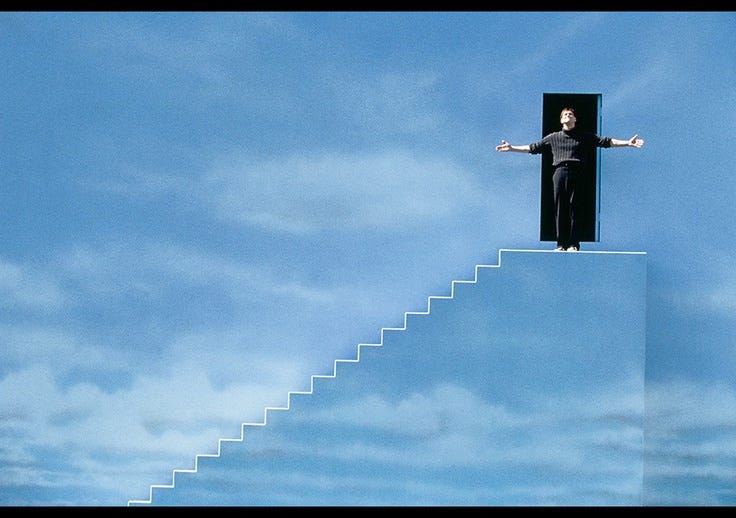
Time for one last media reference. In The Truman Show (1998), the exit door is the gateway to the real world, located at the edge of the massive studio dome. After discovering his world is an illusion, Truman sails through a storm, collides with the painted sky wall, and climbs the steps to an unassuming service door.
Professional ghosting feels different from personal ghosting. Its less intimate, and therefore less legitimate as emotional territory. Nonetheless, the cumulative weight of sustained professional silence erodes confidence and motivation over time.
Students may hesitate to bring their experience of having been ghosted repeatedly to professors, family, or peers, not wanting to seem weak, not wanting to exhaust people’s patience, not wanting to become the person who only talks about their job search.
AI offers a space to process these feelings without social consequence, at any hour, as many times as needed. The absence of judgment and the absence of fatigue in an AI interlocutor can be a useful convenience.
This is not a replacement for human connection and support, especially when with a background in practice, and it is worth being clear with students about that boundary.
But as a pressure valve, a thinking-out-loud space, and a place to articulate feelings before bringing them to a human conversation, can be of some value.
AI can help students articulate their own story in ways they struggle to do alone. Many students, especially after repeated rejection, lose access to a clear and confident account of who they are, what they have done, and what they offer. A conversation with AI that simply asks: what have you built, what did you learn from it, what problems do you want to solve, what kind of practice do you want to be part of and then reflects that back coherently can help restore a sense of professional identity that the radio silence of having been ghosted eroded.
The in-between zone when no longer a student, not yet employed can be disorienting, destabilizing and disempowering in part because it lacks external structure that school provided.
AI can help students design their own structure: a weekly job search plan with realistic goals, a reading list to deepen their professional knowledge, a side project brief to keep their design thinking active, an interim design competition to focus creative energy on, a self-directed curriculum to develop skills that strengthen their candidacy.
The desert becomes less seemingly endless when you have a map.
The limits of AI
AI may be a companionable coach but it cannot replace human mentorship. The architecture profession is fundamentally relational, and the doors that open most reliably open because of human connection, trust built over time, and the kind of advocacy that comes from someone who knows and believes in you. AI can prepare students for those relationships and help them navigate them but it cannot substitute for them.
There is no substitute for being seen and understood by another person who has skin in the game such as a mentor or professor who remembers your progress, who knows your specific struggles, who can advocate for you in rooms you are not in. AI offers a version of being heard, but not that version.
AIs may be able to assess writing and narrative with considerable sophistication, but the visual and spatial intelligence of an architecture portfolio is better evaluated by practitioners and experienced educators. AI is useful at most as a first pass.
The job search, for all its frustrations, is also a developmental experience where you build your resilience and professional identity by learning to navigate a complex world.
Students who use AI to process and strategize use it well. Students who use it to avoid the discomfort of the search itself are not being served well by it.
What I have tried to do for students in this overlong post today, by asking these questions on their behalf, by thinking seriously about their psychological wellbeing alongside their professional preparation, by treating the experience of being ghosted as worthy of intellectual and human engagement is what AI cannot fully replicate.
But can support.
Professors are the human relationship in their professional lives right now.
AI can be the infrastructure around that relationship i.e. the practice space, the research tool, the midnight sounding board, the editor, the patient explainer of a confusing and sometimes insensitive professional world. Used that way, it is a resource for people who may feel they are alone in the desert, trying to find their way to the other side.
We started this post by discussing a linguistic trend and ended up covering professional ethics, generational culture, the psychology of rejection, the dignity of experienced practitioners, and the wellbeing of young people standing at the threshold of their careers.
Here is something that I find hard to say about AI. My students are fortunate to have an AI who thinks about them the way it clearly does. Not just about whether they can draw or detail or design but about whether they will be okay.
Whether they will keep their spirit intact through the hard early years.
Whether they understand that radio silence from a firm is not a verdict on their worth.
I hope some of what we discussed today was useful to you, and to the students we carry with us into that classroom.
Take good care of yourself too. You deserve the same thoughtfulness so clearly extend to others.
Who We Need To Be
When ghosted, be patient and tolerant; assume the best (or neutral) reason, not the worst ones, which is often a misread of the situation; it’s business not personal; without blame, look at what we are putting out there; focus on high quality outputs and always putting your best forward; living well, not losing hope, is the best revenge.