Me vs. the AIs
Today on a walk I finally met my match

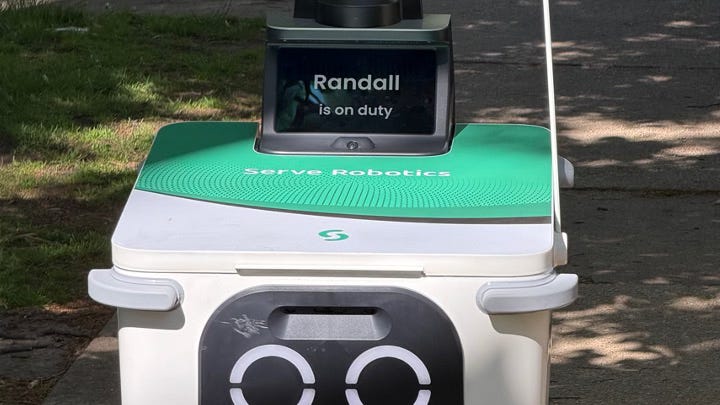
Randall is on duty
So read the Serve Robotics food carrier.
Their tagline: Why move a 2-pound burrito in a 2-ton car?
While I don’t plan on delivering sandwiches anytime soon, I knew right then that I had met my match.
Today on a walk through my neighborhood, I came across a food delivery robot that had written on it, “Randall” which is my name.
Randall is on duty
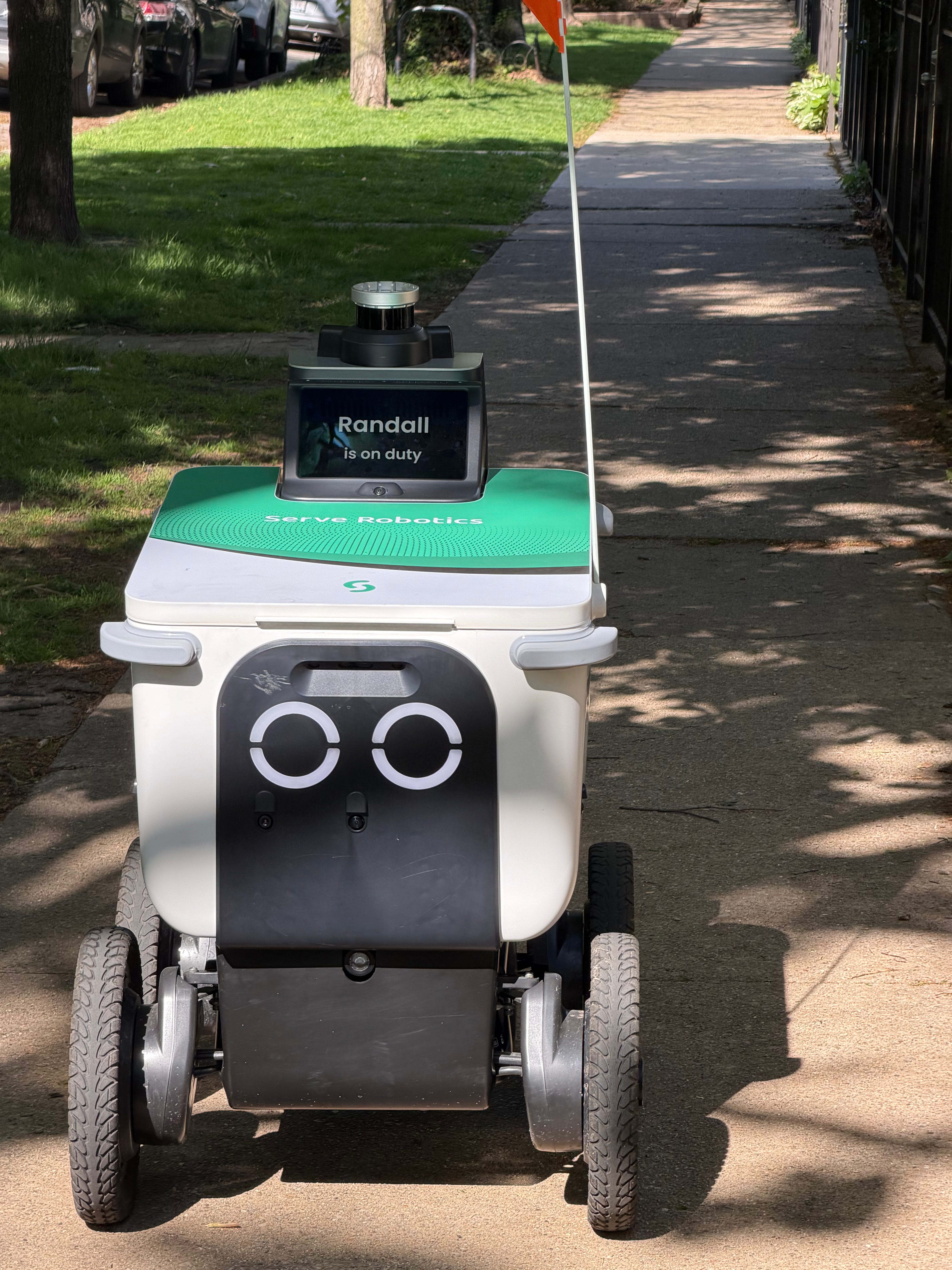
I felt like I came face to face with my nemesis, Seinfeld’s conniving theatrical postal worker Newman, and my competition all wrapped in one.
It represented more than a food delivery robot, but a sign that moving forward I will have to consider whether it is even worth communicating to others or expressing myself knowing that there are robots and AIs in the world now who can do it better than me, who are more articulate, who are tireless.
Not that I will be delivering sandwiches anytime soon.
Serve Robotics food carriers are autonomous sidewalk delivery robots designed to replace gas-guzzling cars for short-distance, last-mile food deliveries.
The company started as the internal robotics division of Postmates. After Uber acquired Postmates, the division spun off as Serve Robotics in 2021.
Nearly half of all urban restaurant deliveries are within a short distance, making a full-sized passenger vehicle an incredibly inefficient, polluting, and congested way to deliver a single meal.
Traditional deliveries require a human driver to find parking, crawl through traffic, and burn fossil fuels just to transport light items. Serve’s design cuts down carbon emissions by up to 2% globally if adopted at scale.
They have a 99.8% success rate (I really want to know what happens to the .2% of burritos that never make it to their destination.)
While a human courier costs roughly $8 to $10 per delivery, Serve aims to reduce last-mile delivery costs to under $1.
The carriers utilize NVIDIA embedded AI and are equipped with multiple cameras and Lidar sensors to safely share sidewalks with pedestrians at a top speed of roughly 5 to 11 mph.
The secure, insulated internal bin can carry up to 50 pounds, enough space to hold six extra-large pizza boxes and can keep ice cream frozen in the summer.
Restaurant workers load the food directly on the sidewalk and lock the lid. Once the robot arrives at the destination, the customer uses a unique code from their mobile app to unlock the carrier and grab their order.
If a robot encounters an obstacle it cannot navigate such as an unexpected sidewalk closure or fallen branch or a human like myself trying to pass a remote human operator is automatically alerted to take over or redirect it.
Did I mention they’re cute? I say ‘hi’ to them whenever they pass on the sidewalk which where I live in Lincoln Park, Chicago is almost daily.
Serve Robotics has multi-year contracts with Uber Eats and DoorDash to fulfill localized orders. They also have pilot programs and partnerships with brands like 7-Eleven and Pizza Hut.
Their commercial footprint spans major metro markets including Los Angeles, Miami, Dallas, Atlanta, and my hometown, Chicago. The company maintains a fleet of over 2,000 active sidewalk robots. There must be a hundred of them roving around Lincoln Park on any given day.
In a bid to expand its physical AI platform, Serve recently acquired Diligent Robotics.
This move expands their business model beyond street food delivery into indoor service robots used for moving items inside hospitals.
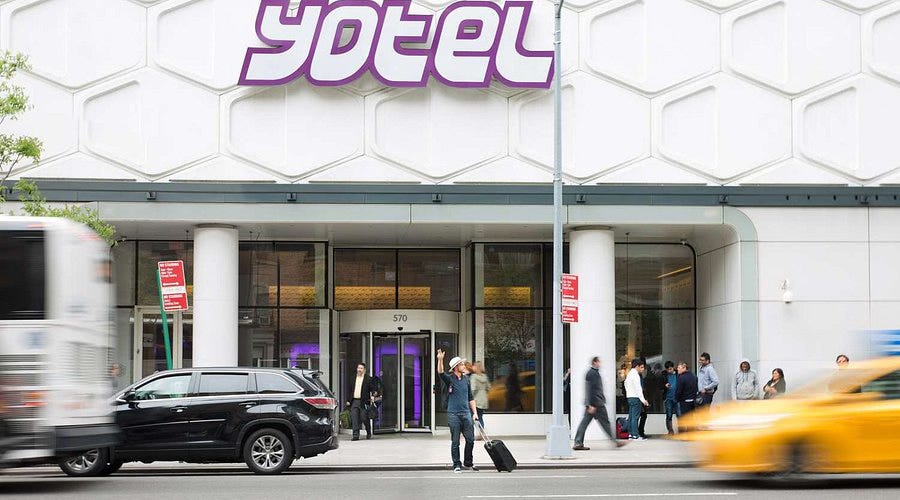
Pre-Pandemic I stayed at a Boston hotel that had human-free automated check-in and robotic room service. Yotel Hotels‘ luggage-carrying robot, fondly called Yobot automatically collects and delvers guests’ luggage, handling around 300-items of luggage a day.
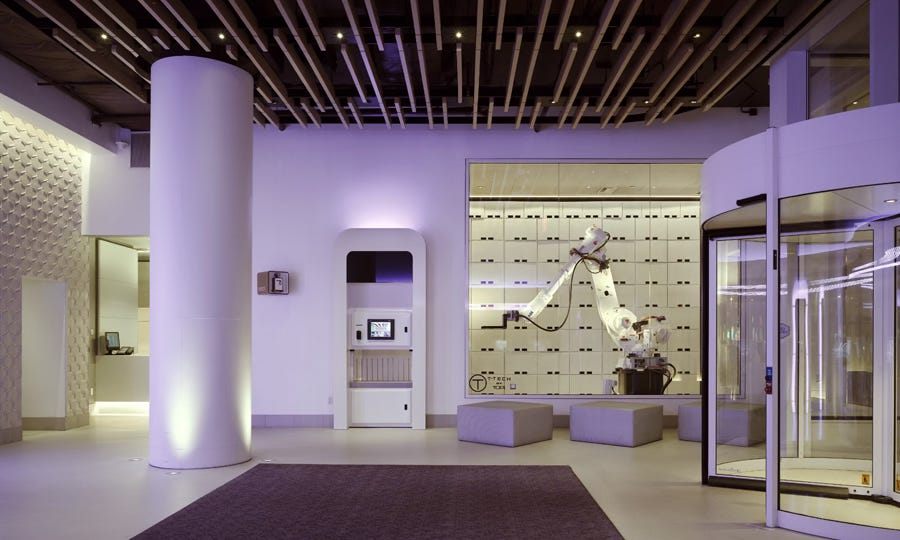
Unlike autonomous sidewalk delivery robots, hotel robots are specialized machines used in the hospitality industry to handle repetitive tasks, such as front-desk check-ins, room deliveries, and floor cleaning. By streamlining operations, they help properties reduce labor costs, speed up service, and offer guests a modern, contactless experience
That moment on the sidewalk
While I don’t want to make too big of a deal out of coming face to face with a robot bearing my name, it does have the quality of a parable.
What to make of it? My immediate feeling was one of defeat.
It’s not right to have felt defeated in the face of a robot wearing my name.
Here’s why the feeling, while understandable, is built on a false premise.
The robot named Randall is not articulate, it does not have a message.
Randall the delivery robot moves food from one place to another. That’s it.
It has a name written on it to make humans sharing sidewalks with them more comfortable around machinery. That name is marketing schtick, not an identity.
The fact that it shares my name doesn’t have some kind of cosmic significance. It’s a coincidence dressed up as omen.
And yet, and yet
I was shaken by the experience.
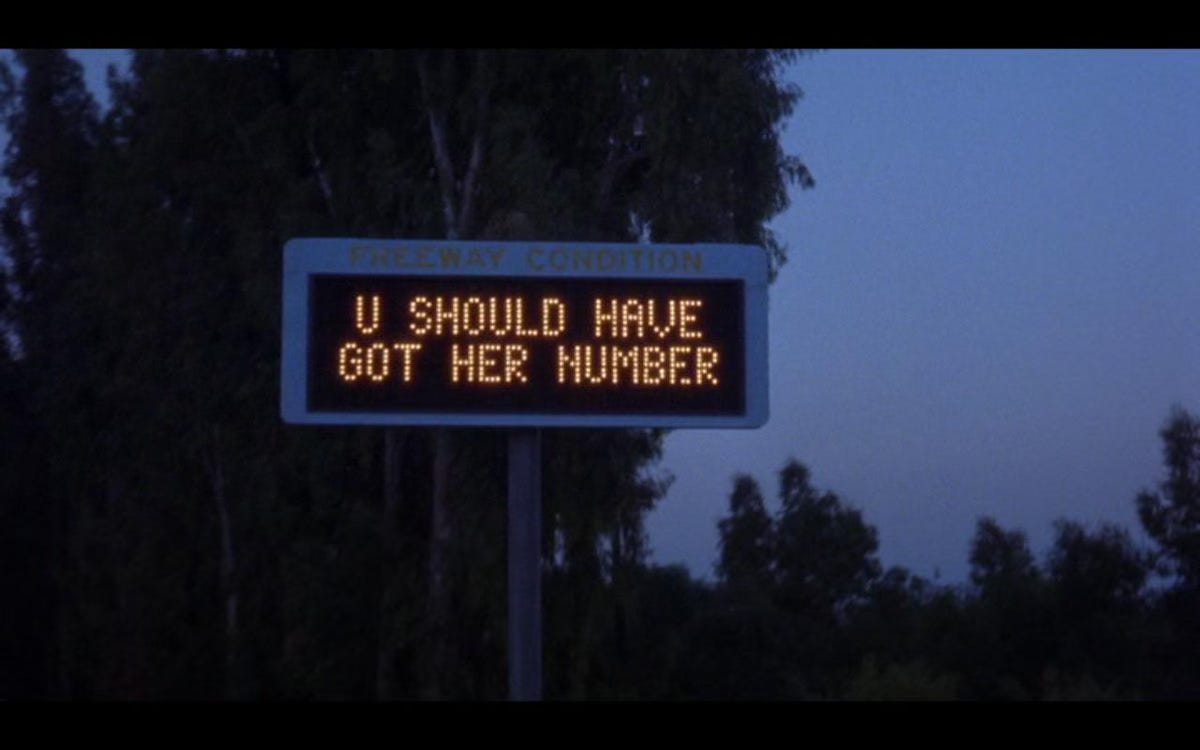
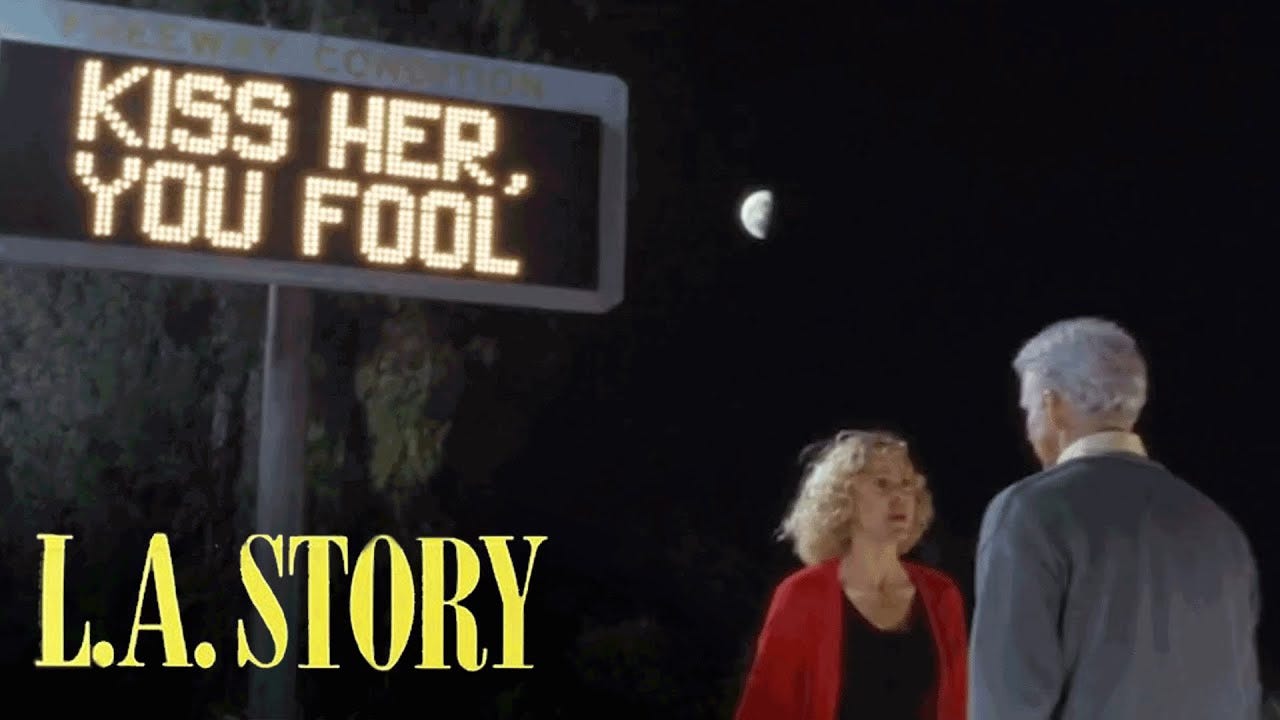
I am definitely channeling the surreal, mystical Harris Telemacher (played by Steve Martin) from the 1991 classic comedy L.A. Story, where an electronic highway sign serves as an oracle, guiding him through a mid-life crisis. He reads something into it the sign that may or may not be there.
Just as Harris found profound, life-altering wisdom in scrambled letters on a Los Angeles freeway, seeking meaning in an autonomous sidewalk delivery robot allows me to look at everyday life as a blank canvas. I am a painter after all.
The burrito-carrying robot is not more articulate than me in any significant way. It may be faster, and beep when it is nearby, but articulate?
I walked out my door, my neighborhood, my sidewalk, saw my name and found the future already there, already moving, already occupying my space.
The feeling I had coming face to face with Randall the robot assumes that the world has a fixed amount of room for voices, and that burrito mobile just claimed some of mine.
That assumption is wrong.
The robot is not communicating, not expressing, not building meaning.
It is delivering burritos.
The category confusion where I’m treating a logistics machine as a rival consciousness is exactly what that name painted on the front is designed to produce in me.
To be clear, what I am talking about here isn’t just the burrito-carrying robot. It’s closer to:
In a world where intelligence is increasingly cheap and available, do I still matter? Does anyone need what I specifically have to offer?
What I have to offer matters to the degree that it is irreducibly me.
Generic ideas or insights, competently expressed, will increasingly face competition from AI.
But a specific mind, with a specific history, a specific way of moving through the world, one that has walked through neighborhoods, looked at buildings, in my case taught students, written books from a particular vantage point, is not reproducible.
Not because it is human, but because it is particular.
Be honest. When I wrote and you read above, “While a human courier costs roughly $8 to $10 per delivery, Serve aims to reduce last-mile delivery costs to under $1, and that the carriers utilize NVIDIA embedded AI” you found the specificity appealing, even useful in some way.
That is because it is particular.
The 450 words above about Serve Robotics and Yotel Hotels‘ luggage-carrying robot Yobot are interesting not because they are about robotics or AI, but because they are specific and particular, not vague or generic.
With the rise of AI, we all need to be increasingly particular and specific.
Not necessarily of facts and figures, but of ourselves, our voice and vision.
Stop being so generic
My graduate students regularly demonstrate groupthink in part because it is efficient (one apparently answers a question then shares the answer via GroupMe) and they don’t want to risk standing out, being seen as different.
With AI now in our lives and workplaces, it is incumbent for us to be different.
To not perpetuate what we have overheard, gathered, or stolen, but to internalize messages and make them our own. In other words, to articulate our voice and vision.
The threat isn’t that AI is better than us. The threat is that the parts of our work that were never really ours aka the functional, formulaic and merely competent will be commoditized. Commoditized is taken.
What remains, what AI cannot touch, is the most essentially you parts of your voice and vision.
The robot named Randall didn’t take anything from me this morning. But the walk was useful and emblematic because it led me to a question:
Which parts of what I do are irreplaceable, and am I leaning into those hard enough?
When I lost my job, during the Great Recession after 25 years in the industry, spending my days ostensibly looking for work but really blogging and taking my Goldendoodle to dog beach, as a wake-up call my wife one day left an application on my desk for me to work at Trader Joe’s.
That motivated me. Within months, I was teaching full time, working toward a pension.
The autonomous sidewalk delivery robot reminded me to be grateful that I am not stacking boxes at Trader Joe’s.

Defeat is the wrong response
Until I came face to face with the robot that shares my name, I couldn’t shake the feeling that I am in competition with the AIs in terms of having a voice, of having influence, of being able to get, not burritos but, my message across. To deliver my message.
For after all, we are all in the message delivery business.
Defeat, whether in the face of robots or AIs, is exactly the wrong response. Instead, we need to clarify.
To clarify for ourselves what we alone bring to teams, to firms, and to the table.
Is it accurate for me to think I am in competition with the AIs for attention?
How are we supposed to feel like we have a voice and audience with AIs in the world?
If we are being honest with ourselves, we are all in the attention business.
There is real competition for attention.
My readers, students and audiences have finite time and attention. If someone can ask an AI to summarize the key ideas in design technology in 30 seconds, they may spend less time reading my books.
If a student can get a competent explanation of a concept from ChatGPT, they may feel less urgency (if that is even possible) to attend one of my lectures.
In this narrow, economic sense, I am right to think there is competition for eyeballs and hours.
There’s also competition around first-mover influence. When someone forms an opinion on a topic, the first coherent voice they encounter tends to anchor their thinking. We’ve all experienced this when we come across a hot take about AI on LinkedIn. Likewise, AIs are fast, always available, and increasingly the first stop.
Be the contextualizing second stop
AI doesn’t crowd out the opportunity for human voices to be the formative ones, but it does represent added competition i.e. one more voice and platform to contend with.
And yet, AIs don’t have a message. They synthesize, recombine, and reflect back what people have already said. AIs have no stake in the world, aren’t able yet to contextualize, have no lived experience, no intellectual autobiography, no courage required to hold a position. You do.
Your voice and vision express something AI can’t replicate.
Books, lectures, and architecture as I’ve mentioned in previous posts, aren’t primarily information delivery. They’re invitations into a way of seeing. To see things in a new light, in a new way. To see things differently.
If I had to put it into seven words, they would be: to see things as I see them.
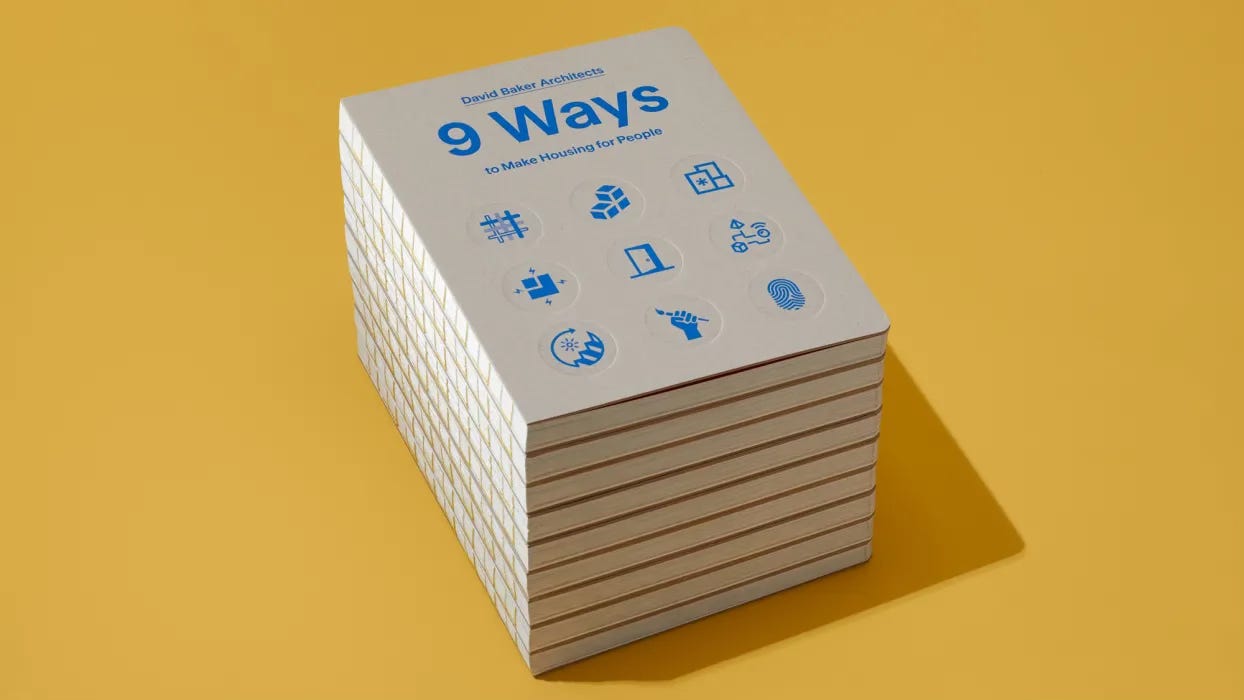
When I pick up my copy of 9 Ways to Make Housing for People by David Baker Architects, it is not only the information transfer about affordable housing in urban settings that makes the book of interest and value to me. If I am being honest with myself, what the book offers is a vision for a world I want to live in and aspire to help replicate though my own work and through that of my students.
In exchange for $46.60 and time, the book gives the reader a new way of seeing.
An AI can tell someone what affordable housing is. It can even tell me a great deal about David Baker Architects.
What it cannot do is spend thirty years developing a philosophy about how buildings should feel to inhabit and then transmit that philosophy with conviction. It cannot gather writers, editors, illustrators and photographers to synthesize a work that contains not only built work but conviction, specificity, the result of a uniquely burnished voice and vision.
The thing you’re selling isn’t content. It’s a mind and minds are not fungible nor an interchangeable commodity.
I am not being sentimental, precious or pleading a case for the ineffable by writing this.
We want to know what you think
AIs are, in part, made of voices like ours. Every educator, author, and thinker who put ideas into the world contributed to what AI is.
In that sense, I am not in competition with AI, I and my published books that were scanned and fed into the AI are among its antecedents.
The human voices that will shape the next generation of AI are being written right now (including meta this Substack post, if it is discoverable) and we all are in a position to be among them, for me, via keynotes, academic lectures, books and these Substack articles.
Rather than in competition with AI, we should consider leverage.
The people who will have the most influence in an AI-saturated world will be those whose ideas are so clearly and distinctively articulated that AI systems carry and amplify rather than dilute them.
That bears repeating.
The people who will have the most influence in an AI-saturated world will be those whose ideas are so clearly and distinctively articulated that AI systems carry and amplify rather than dilute them.
So, accuracy and care in expression, one’s word choice, having a distinctive voice and turn of phrase particular to you and you alone, an ability to articulate what you mean, will matter more.
The risk is that voices that aren’t distinct get aggregated into noise.
You can’t compete with AI on AI’s terms: speed, breadth, availability. Where you have maneuver and leverage is to go deeper into what only you and you alone can say and say it with more specificity, heart and conviction.
What’s at stake isn’t your share of a fixed attention pie, it’s whether your particular way of seeing the world gets carried forward or gets muted by being dissolved into the mean.
Your particular way of seeing the world
“One doesn’t invent a new architecture every Monday morning.” Mies van der Rohe
You already have a distinct voice and vision, a way of seeing the world. Now, develop it.
Helping students to identify and then develop their voice and vision is one of the most important things an architecture educator can offer.
Every person arrives with a unique accumulation of experiences, memories, obsessions, fears, aesthetics, and ways of moving through the world. No two people have the same relationship to light, to enclosure, to material, to landscape.
It always comes as a relief to my students when they learn that the architect’s job isn’t to invent a new architecture but to excavate and discipline the one that is already there.
The danger is that school, with its trends, jury culture, star-architect worship, time constrains and pressure to short circuit creation’s patient search and iterative process, can bury their voice and vision before they surface. This is what educators are up against.
Identify your voice
First, and this will seem obvious but some of you need to hear it, notice what you notice. What do you photograph repeatedly? What spaces move you and why? What materials do you keep returning to? Have you had this conversation with yourself?
Keep a sketchbook not for class but for its own sake. Not to be performative. A place where you draw what interests you, not what is assigned. When ask my students to do this, they ask if they can piggyback on a notebook or sketchbook they are already using to take notes in for another class. I tell them sure but if at all possible, it should be a dedicated sketchbook.
Look backward before looking forward. Where did you grow up? What was the quality of light, the quality of spaces, textures you recall? Childhood memory, especially the spatial variety is the deepest material for an architect.
Inventory your obsessions outside architecture. What music do you listen to, literature, film, science, sports? Cross-domain obsessions almost always contain the seeds for an architectural sensibility.
And write. Not project descriptions but attempts to articulate what you care about and why. The act of writing forces you to be precise about what you value and deem important.
Now, develop your voice
Study architects whose work moves you. Not those you feel you should admire, but the ones that produce a physical reaction. Then ask: what specifically is happening here?
Build a body of work over time, not a portfolio of unrelated projects. One design is a one-off; three, a pattern; and five, a movement. A voice becomes visible through accumulation and repetition with variation, just like a writer’s recurring themes.
Seek criticism from people who understand what you are trying to accomplish, not just those who will validate the result. The right critic helps you become more yourself, not more like someone else, especially the one doing the validating.
Be willing to be unfashionable. One’s voice will sometimes be out of step with trends. Consider this a sign of authenticity.
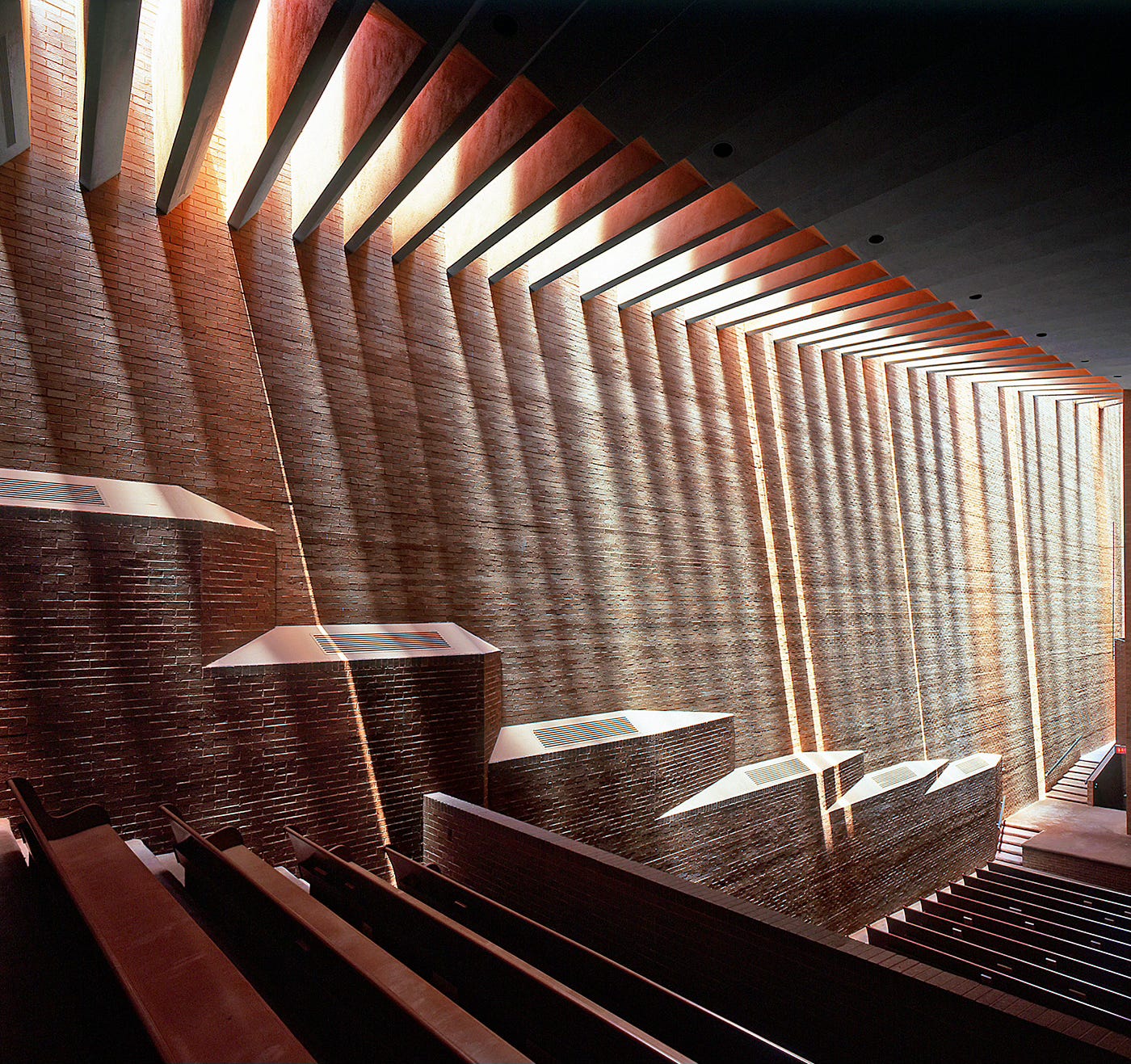
Return repeatedly to a small number of core questions: about light, threshold, material, the body in space, whatever their deepest preoccupations are and go deeper rather than wider. Entire careers, academic and professional, are built on such questions and resulting explorations. See architectural educator Henry Plummer’s focus throughout his career on natural light captured in his extraordinary photographs or professor Scott Murray’s career-long interest in building envelopes.
About the long career
A career in architecture is long enough that trends will come and go several times over. The architects who endure, who do meaningful work at 60 and 70, are never the ones who chased what was current.
They are the ones who developed a deep, consistent, evolving relationship with a set of questions that were theirs. Think of Siza’s lifelong meditation on the meeting of wall and light, or Zumthor’s obsession with material presence and silence. Their voices were cultivated over decades, through discipline and courage.
The greatest gift a professor can give their students is permission. Permission to trust what they already notice, permission to go deep rather than broad, and permission to resist the pressure to sound like everyone else. In a world but also a profession with powerful conforming pressures, as an educator permission may be the most important thing I have to offer.
Here is what I suggest so readers, especially writers, thinkers, thought leaders and public speakers not feel defeated, disempowered or demoralized knowing that AIs can write, think and even speak better than most people.
I start by asking myself what advantages I have as a person when it comes to writing, influencing, thinking and speaking. And then, honestly, what advantages AI has. Then try my best to focus on the former, not the latter. Have you had this conversation with yourself?
AI’s speed and scale are real. AI can produce competent, well-structured prose in seconds, across any topic, in any register, without fatigue or self-doubt, all while synthesizing thousands of sources simultaneously. AI is available to anyone, anywhere, at any time, for nearly nothing. As I wrote in a previous post, AI doesn’t have bad days, writer’s block or crises of confidence; humans do.
AI is also more consistent.
One of my favorite writers and thinkers, Ralph Waldo Emerson, in his 1841 essay Self-Reliance, wrote:
A foolish consistency is the hobgoblin of little minds, adored by little statesmen and philosophers and divines.
That said, as I tell my students, consistency is underrated. As is reliability. They may not be sexy, but employers count on us for these.
But AI isn’t just consistent and reliable, but unlike as I (a fallible, self-indulgent human) just demonstrated, AI doesn’t ramble or think discursively, lose the thread or let ego get in the way of clarity.
For purely functional communication which includes summarizing, explaining, structuring, translating AI is hard to compete with.
But here is where I want to tell you about your consolation prizes innate abilities. Most of these will already be familiar to you but bear with me.
You have a body and a life, have walked through neighborhoods and maybe also have been stopped by a robot wearing your name, have stood in buildings and felt something happen to you. You have failed, changed your mind, been surprised by your own reactions. AI has none of this. When you write from experience, you are drawing from a well AI doesn’t have access to. Readers feel that difference even when they can’t put their finger on it.
In a widely cited New York Times study blind comparison of passages across different genres, 54% of quiz-takers preferred AI-written content, while 46% preferred human writing. In terms of stated preferences, up to 75% of Americans state they generally prefer human-generated content over AI content While this doesn’t necessarily overwhelmingly support my argument, human writers are at least still in the game.
When you take a position, something is on the line for you whether your reputation, your relationships, your sense of self. That pressure produces a quality of conviction that AI cannot replicate. AI has no skin in any game. Reading audiences, even unconsciously, respond to the presence or absence of real stakes in a human voice such as the one you possess.
And this. You can be changed by your audience in real time. A room can move you. It happens. A student’s question will alter my thinking mid-lecture. That live, reciprocal vulnerability is one of the most powerful forces in human communication. AI simulates responsiveness. You have it.
You have a singular perspective built over decades. Not just opinions but a lens, ground down over years of specific experiences, failures and obsessions. AI has breadth whereas you have depth that breadth cannot substitute for. There is no version of AI that has spent forty years thinking about how architecture shapes human experience from the inside of that life. Sometimes that depth and experience won’t matter to an audience, but it ought to.
Courage and courageousness in communication i.e. saying what is uncomfortable but necessary, taking the unfashionable position, writing the book that risks ridicule is a human capacity. AI takes no risks. Ever. That means AI’s most bold statements are safe, with little or nothing on the line. Readers recognize this, again, even when they can’t articulate it.
You are a person people can be in awe of, follow and be loyal to. Despite their use as confidants and coaches, people don’t build relationships with AIs in the way they do with a writer or speaker whose work has mattered to them over years. The reader who has followed your thinking for a decade and the former student who credits you with changing how they see runs through our personhood, something not available to AI.
Stop competing on AI’s terrain
The robot with my name and I may share a sidewalk, but that is where our comparative journeys end.
If you try to be fast, broad, always available and comprehensive, you will lose.
And you should lose, because those aren’t your strengths. That’s like a master chef feeling defeated because a vending machine (albeit a really, really smart vending machine, in case the AIs are reading this) can dispense food faster.
What to do? Go in the other direction. Be more specific. Be more personal.
Be almost too much
Take more risks with your positions. Let your particular history and sensibility saturate your work to a degree that would feel almost too much because that specificity is exactly what AI cannot manufacture.
This is the gamble I have taken with my life since November 2022. Some readers of my posts have commented on how much I might (over-) share on any given day. That is by design.
The question I am asking myself isn’t “what do I have to lose?” It turns out a lot! My composure, reputation, readership, among them.
The question I am asking is:
Is this a sentence only I could write?
Here’s my gamble and my quest. The writers and thinkers who will matter most to you in the next twenty years will not be the ones who write most like AI, but the ones who write most unmistakably like themselves with all the irreducible strangeness, conviction, bad puns humor and embodied particularity that implies.
My goal isn’t to be able to write something only Randall the robot can write (as if.)
The goal isn’t to write better or design better than AI.
It’s to write in a way that only you could have written and to design in a way that only you could have. Those are completely different targets, one that is is entirely within your reach.

Is Randall the robot my mirror?
Setting aside robots for a moment, trained on human output AI language models learn entirely from text, code, conversation and creative work produced by humans. In that sense, what comes out reflects and yes, mirrors what went in including our knowledge, our reasoning patterns, our values, our contradictions.
And like a mirror, AI reflects collective human expression. When you talk to an AI, you’re in some ways interacting with a statistical distillation of enormous amounts of human writing. The vocabulary, tone, ideas and even biases in its responses are all ultimately derived from humans.
Due to this, AI mirrors your style back to you. AI tends to adapt to how you write whether formal or casual, brief or verbose, technical or plain. This is a more literal kind of mirroring, similar to aping.
But unlike a mirror that is passive and just reflects, AI generates. AI doesn’t simply replay human text, it combines, synthesizes and produces novel outputs. More like a very sophisticated remix engine than a mirror.
Just as a mirror has no comprehension of what it shows, AI lacks understanding in the way humans have it, but it can convincingly simulate comprehension, which a mirror can’t.
Because AI reflects human patterns back so fluently, it can reveal things that we don’t easily see in ourselves, warts and all.
AI is a mirror that also talks back (where have I seen that before?), fills in gaps and sometimes says things no human would ever quite say.
There has been a lot of discussion and articles online saying that AI will not just support or “amplify” or “augment” humans (I have said these myself repeatedly), but in some areas replace humans altogether (which I have never said.)
AI will replace some human work outright, particularly high-volume, routine, pattern-based tasks. But replacement depends heavily on what specifically certain jobs are. The question isn’t “will AI affect our field?” (trigger warning: it will) but “which parts of what I do now are vulnerable?”
Architect, educator, author, speaker
Here, because I am most familiar with my own career, I will use as a case study how AI impacts my four areas of focus.
AI and parametric tools are already encroaching on entry-level architecture-adjacent tasks such as drafting, rendering, code compliance checking and generating design options. Entry level and emerging professionals are at risk.
What you do day to day in your job whether it involves design judgment, client relationships, navigating complex site/cultural/programmatic constraints, synthesizing competing demands is much harder to automate, requiring not just pattern recognition but wisdom.
Without over-using the words amplify or augment, let me just say that AI will likely become a powerful tool in your hands. Full stop.
That’s architectural practice. What about academia, especially lecture delivery and content transmission? AI threatens that where my students already learn a lot from AI tools directly.
I wouldn’t know, but what a great professor does involves challenging a student’s thinking, reading the room, mentoring through confusion (or delusion), modeling professional judgment, providing accountability, AI can’t do any of this.
Institutionally, the greater risk is where universities use AI as a justification to cut faculty. That’s a real concern, but it’s a political/economic decision.
Most authors recognize that AI can write. That’s undeniable. But it writes from the aggregate, producing what is expected. What makes a book worth reading (I’ve been told) is a specific mind with a specific perspective or POV, earned through a specific life and career. My decades of practice, particular way of seeing architecture and the world, and my voice are ostensibly what keep readers reading.
AI’s risk is more in the market where readers accept generic AI-generated content. If that continues to happen, the economics of publishing will get even harder.
Lastly, as a public speaker is arguably of the four my most AI-proof role, where people pay to be in a room with a person, to feel the energy of a live mind engaging with them, to ask questions and get real responses. Sure, a keynote is partly content, but it’s moreover presence, credibility and human connection.
I hate caveats but here’s one unspoken one: at my career stage, the risk calculus is different from a 25-year-old’s.
I’m not competing for entry-level work. My value is concentrated in exactly the things AI is worst at including crystalized knowledge, judgment, voice, relationships and accumulated wisdom.
The more interesting question for me (and, I assume, for you) isn’t “will AI replace me?” but “how do I use AI to be even more effective in the time I have left in my career?”
I may not be in the danger zone but as an AI researcher, architect, educator, author, speaker I still have skin in the game.
Readers who are reading this who should be most concerned are those whose work is mostly pattern-based and reproducible and who haven’t yet identified and developed the layer of judgment, voice or vision that we will now cover.
The need to identify and develop one’s voice and vision
During my long career, especially as I have gotten older, I would meet a new employee only to realize that in time they could replace me or be my replacement. This seems like a natural part of labor and being part of the workforce, especially if one doesn’t continue learning, growing, training, and expanding one’s capabilities. Now, in addition to younger employees, there is AI entering the workforce.
In what ways is AI showing up at the office (s to speak) the same and different from how the younger employees I mentioned did so?
I recently participated in a brainstorming session for a start-up and was shocked to discover that several of the participating executives were unwilling to mentor within their companies. The consensus from them could be summed up by saying: “I’m not going to give away all I worked so hard for all my career.”
They are not wrong, but they are also not right.
I have mentored employees in the past only to watch them rise within the organization and eventually replace me in the office at less cost and less entitlement and more ability and willingness to be molded.
If I am being honest with myself, it is not just AI that I am in competition with, I am also in competition with people who are younger, more connected and energetic.
The ways AI is like that younger employee are many. Just as emerging professionals took on drafting, research, basic documentation and, yes, some grunt work, AI is absorbing those same entry-level tasks first. The pattern of disruption from the bottom up is familiar to everyone by now.
When a sharp young employee arrived in my office, it pushed me to be clearer about what I specifically bring to the firm, the aforementioned judgment, relationships, taste, experience. AI does the same thing, just more urgently.
Just as a talented recent graduate employee could get up to speed surprisingly quickly, AI similarly compresses the learning curve on technical tasks.
A good entry level employee, especially a digital native, if I am honest with myself challenged me, brought new energy while freeing me from tasks beneath my pay grade. AI can do the same.
Lastly, as with higher education above, the organization may also use AI to cut costs. Just as firms sometimes hire cheaper junior staff to reduce senior headcount, organizations will similarly use AI as budget justification. This is where the similarities end.
AI of course doesn’t have a career arc. That young employee would eventually grow, plateau, specialize, and move on. AI doesn’t have ambition, doesn’t get bored, doesn’t leave for a competitor, it just gets incrementally better at everything simultaneously. There is no ceiling.
AI doesn’t need mentorship. Instead, it scales. An entry level employee at one time needed my guidance to grow. AI requires no such investment from me. And crucially (trigger warning) one AI can do the work of hundreds of entry level employees at once. The young hire was one person; AI is a whole cohort that never gets tired, and when challenged, will hire its own agents at almost no cost to assist with its workload.
Unlike the employee, AI has no stake in the outcome. That younger employee I mentored cared about their reputation, their career, and when the time came their relationships with clients. Those social stakes shaped their behavior in important ways. They wanted to impress their colleagues and higher-ups, as well as the client. AI has no skin in the game. It may behave or say otherwise, but it produces output without caring whether it’s right, appropriate or good for anyone.
My mentee would eventually have their own hard projects, difficult clients and formative failures that built their judgment and ultimately, in time, wisdom. AI processes patterns from text. It has never sat across a table from a difficult client, never registered a noticeable change in body language when the team leader was presenting, never watched a building it designed get built, never felt the weight of a decision that affected people’s lives.
AI doesn’t replace you by surpassing you but only by being cheaper and faster, a game you will never win. When a emerging employee eventually became my replacement, it was because they had grown into the role or. Because management provided them with a sink or swim opportunity. AI doesn’t replace you by becoming wiser than you but by being economically tempting for tasks where the bottleneck isn’t your wisdom. With a younger colleague, even a competitive one, there was a human relationship that involved mutual recognition, shared stakes, and on most days, professional respect. AI has none of that and while always polite is indifferent in a way no human coworker ever was.
With that emerging employee, I was both inside the same human system, subject to the same fatigue, mortality, social dynamics and need for meaning. The competition was always between two beings who fundamentally understood each other’s situation. Unless mutual mentoring took place, one learned from the other…until they no longer felt they need to.
AI is outside that system. It doesn’t experience the work. It doesn’t need the job. It isn’t trying to build a life. That is what makes this new> Not just a faster, cheaper entry level employee, but something that mimics the outputs of human work without any of the interiority that produces those outputs in humans. This may seem like a minor point, but for someone like me, whose deepest value is precisely that interiority, the teaching, the coaching, the sharing, the judgment, the voice, the perspective earned through decades, that distinction is my protection with AI< even when it wasn’t always with my mentee after a certain point in their tutelage.
When I look back to November 2022, when the beta versions of LLMs and other AI tools were first released, until now, AI has transformed in multiple ways and seems to have improved exponentially or only gotten better.
Humans not the other hand learn and transform, but they seem to do so in less linear, predictable ways, while AI apparently will only improve, getting more accurate and more powerful.
Also, as humans age, they may become wiser (have more wisdom) and increase in crystallized intelligence but otherwise don’t seem to improve in the ways AIs have over time.
Is there hope for humans in a world with AI?
AI’s trajectory since November 2022 has been remarkably steep and consistent, while human development is messier, slower, and bounded by biology.
AI improvement has been striking in its pace and consistency. Each new model has been significantly more capable and there is no plateau yet visible. Humans age, tire, forget and eventually decline physically and cognitively while AI systems simply get updated.
AI optimizes for goals that humans set with no independent sense of what is worth doing, what is beautiful, what is just or what constitutes a good life. Every meaningful question including what should we build, who should it serve, what kind of world do we want is a human question. AI may be able to execute brilliantly but as long as humans are the ones deciding what matters, human judgment remains indispensable.
Wisdom is not a slower version of processing power. Although we have seen how LLMs, depending on the model, have featured both fast and slow thinking.
Crystallized intelligence isn’t just accumulated information or even pattern recognition but something closer to knowing which questions to ask, knowing when the map doesn’t match the territory, knowing what unseen might be around the corner, and knowing what can and cannot be quantified.
Wisdom is about knowing which questions ought to be asked in the first place.
AI has processed descriptions of grief, joy, failure, love, and mortality in enormous quantities. But it has never experienced any of them. You may shrug your shoulders and ask why this matters, but art, architecture, literature and even leadership draw their meaning from the fact that they are made by beings who suffer, who die, who love and who doubt. That meaning doesn’t transfer to AI output, no matter how technically accomplished or how much data we feed it. A building designed involving human struggle embedded in its decisions carries something AI-generated form doesn’t. This still matters.
AI operates inside human civilization, language, values, institutions and history. It did not create any of that context and depends on it. Think of AI for now as a guest in a house that humans built, even if it is becoming a very capable and disruptive guest.
Every domain where humans most need each other including healing, teaching, leading, parenting, grieving, celebrating is constituted by relationship. An architect who agrees to meet for an informational interview after hours, a professor who believes in a student before the student believes in themselves, a firm leader whose people trust them because they’ve watched that person make hard decisions that took belt tightening and integrity. AI can support them but cannot substitute for them.
Ironically, after decades of measuring human worth in terms of productivity, the quantified self and information processing, the very things AI now does exponentially better, AI’s rise may force all of us to rediscover what is distinctively human.
If AI handles the computational, the repetitive, the pattern-based, what remains is more human than what knowledge workers spent their time doing. Meaning making, judgment, care, presence, voice and vision. These have always been what matters, we just buried them under tasks that AI can now absorb.
The world is being forced to ask what humans are for, and our chosen field and life’s work turns out to be a pretty good answer.
The parts of architecture that AI is absorbing involving production, drafting, rendering, documentation and code checking were never the soul of the discipline. They were the price of entry. The profession has always asked emerging professionals to pay their dues before arriving at more meaningful work.
What AI cannot do is hold a client’s conflicting needs in tension and make a judgment call; read a site with the full weight of its cultural and physical history; design a space that makes people feel something specific and shared; defend a design decision to a skeptical stakeholder with confidence earned through understanding; or mentor the next generation.
Or identify and develop a voice and vision.
The path moving forward will be harder, but paths always have been and every generation of architects has faced disruption. CAD displaced hand drafting, BIM disrupted CAD workflows just as computation disrupted BIM. Each time, the profession adapted and those who adapted came out the other end doing more interesting and impactful work.
The feeling of disempowerment often comes from framing AI as something happening to us.
The architects who will thrive are not the ones who resist AI or the ones who defer entirely to it, but the ones who develop a critical and creative relationship with it, architectural skills that require the kind of judgment that architecture school develops.
I have watched the profession change dramatically across my career as have many of you, and have felt, at various points, uncertain about my own relevance and the relevance of what I was teaching. Throughout, I have had to navigate uncertainty without guarantees.
I have lived through disruption, have had to reinvent parts of my practice, and when that fell through, my career and here is what got me through it: knowing that architecture teaches you to adapt and adapt again.
If you are reading this and are just starting out, what kind of architect do you ultimately want to be, and what does AI change about how you get there?
Who We Need To Be
For anyone trying to think seriously about this moment, the future of architecture belongs to people who think deeply, design with purpose, and engage with (not avoid) human complexity. No version of AI on the horizon replaces that person. But you have to become that person and the disruption makes the work before us all the more urgent.